
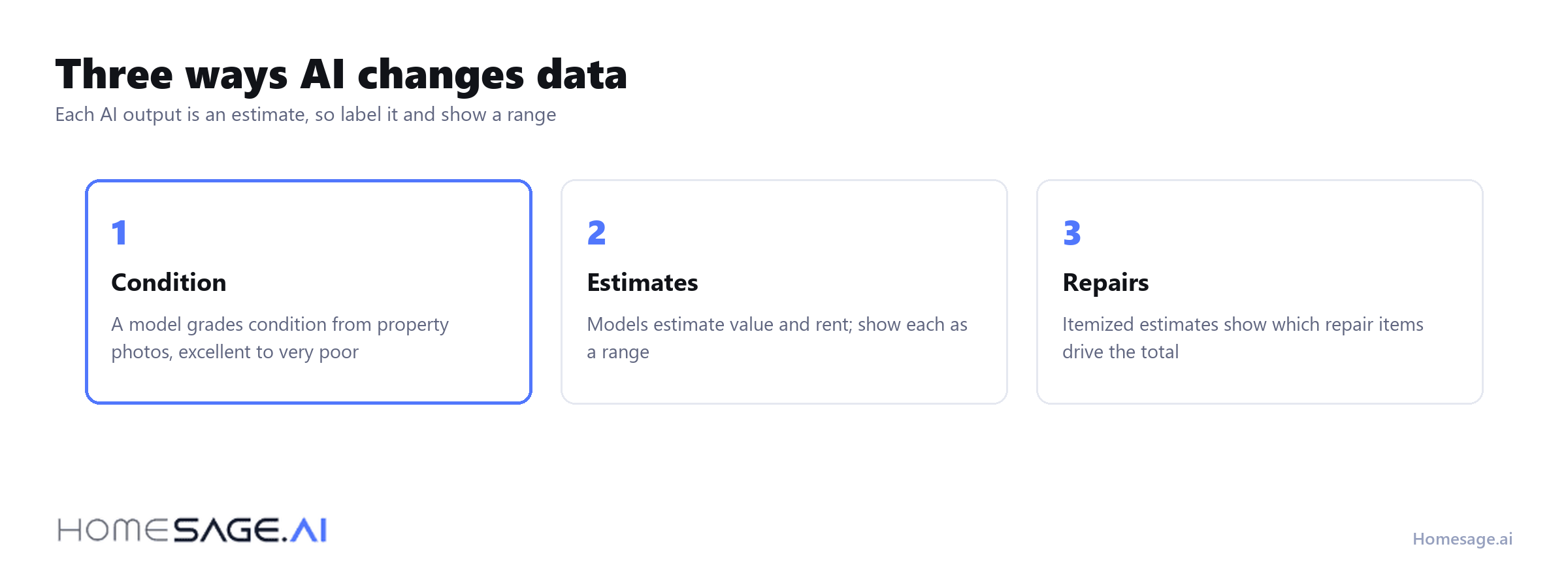
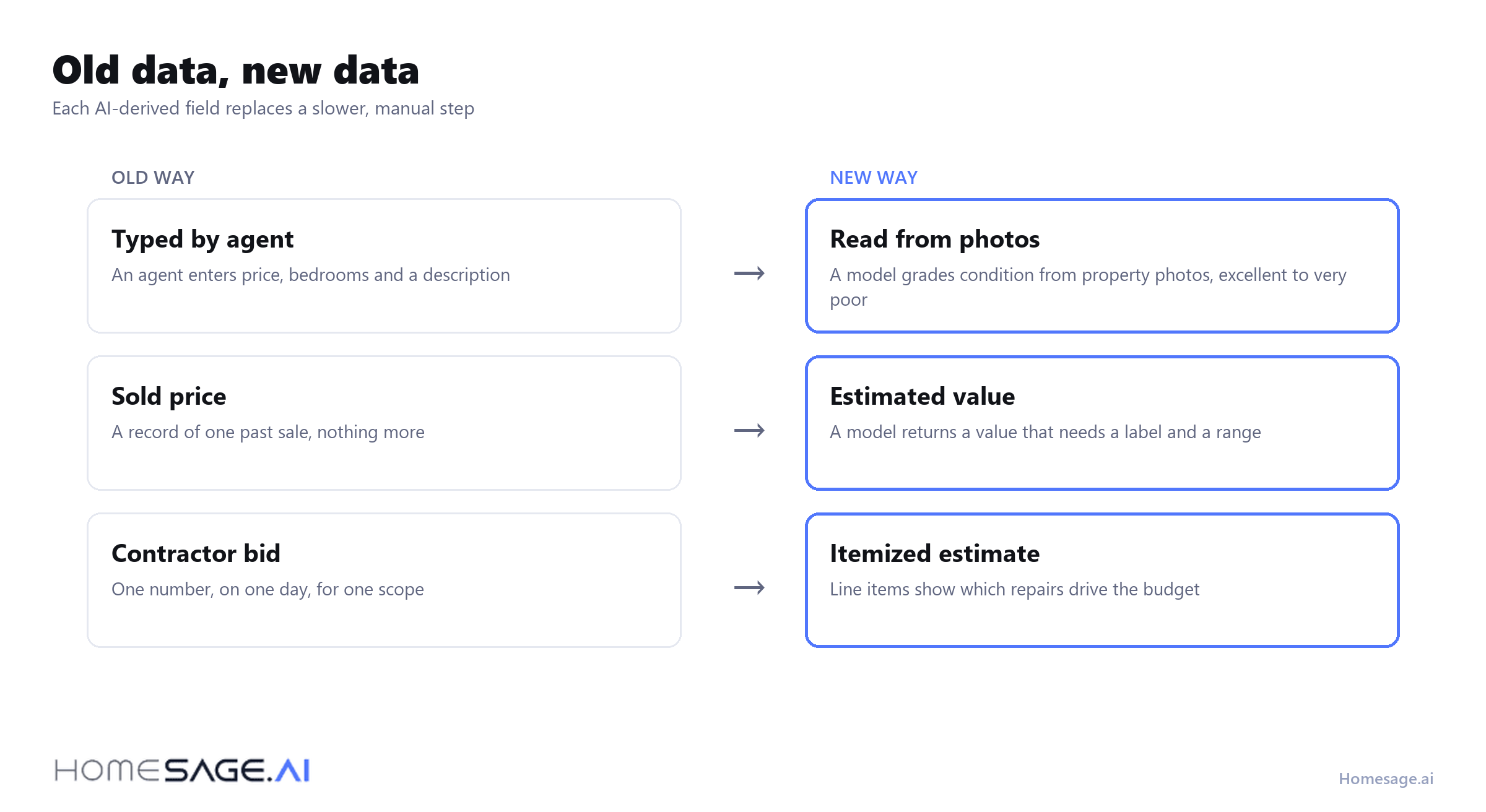
Listing data used to be typed by people. An agent entered the price, the bedrooms and a description, and a buyer read them. Today a model can also grade the condition, estimate the value and itemize the repairs.
That is new data, and it behaves differently. This guide covers the 3 changes, what they mean for people who buy property data, and why every estimate needs a label.
What changed in property data
Traditional listing data is entered by people and follows shared field names. The RESO Data Dictionary is the industry standard for those names, so a bedroom count means the same thing across systems. The data is a record of what someone reported.
AI-derived data is calculated from other inputs. Nobody types it in. A model reads photos, compares sales or prices a repair list, and returns a number. That number carries an error that a typed field does not.
Typed data compared with AI-derived data.
| Data type | Where it comes from | How to treat it |
|---|---|---|
| Listing fields | Entered by an agent or seller | A record to verify when it matters |
| Condition grade | Read from property photos by a model | A screening signal, not an inspection |
| Value and rent | Estimated by a model | An estimate with a range |
| Renovation cost | Itemized by a model | A budget to check with a bid |
Condition grades read from property photos
The first change is that condition becomes a field you can filter. A model reads property photos and returns a grade from excellent down to very poor. The Full Property Report shows that grade next to the other inputs.
Before this, condition came from an appraiser. The Fannie Mae Selling Guide says the appraiser assigns a standard rating, from C1 to C6, to the subject and each comparable sale. The page is dated 4 June 2025. The rating follows a site visit.
A photo grade is a different tool. It covers every listing with photos, so you can rank a market in minutes. It cannot see inside walls, under floors or on a roof. The grade tells you where to look first.
A photo grade ranks a market. A walk-through confirms the house.
Model-estimated values and rents
The second change is that values and rents arrive as model output. An estimated after-repair value (ARV) and an estimated rent come with the report. You no longer wait for a comp pull to see a first number.
The catch is that a model describes a typical house, and yours has its own layout and finish. Pull sold comps that you choose and set your offer from them. An estimate is not an appraisal.
Lenders already treat these models with care. The CFPB rule on automated valuation models requires quality control for them, including random sample testing and reviews. It took effect on 1 October 2025 and covers loans on a consumer principal dwelling. Investors can copy the habit by sampling their own results.
Rent needs extra care. Verified rent is a rental record, and an estimated rent is a model output. They are different fields, and our test below shows how rarely the first one exists. For the decision that follows, see where AI helps investors and where you decide.
Itemized renovation estimates
The third change is the repair budget. A contractor bid is one number on one day for one scope. An itemized estimate breaks the budget into line items, so you can see which items drive the total.
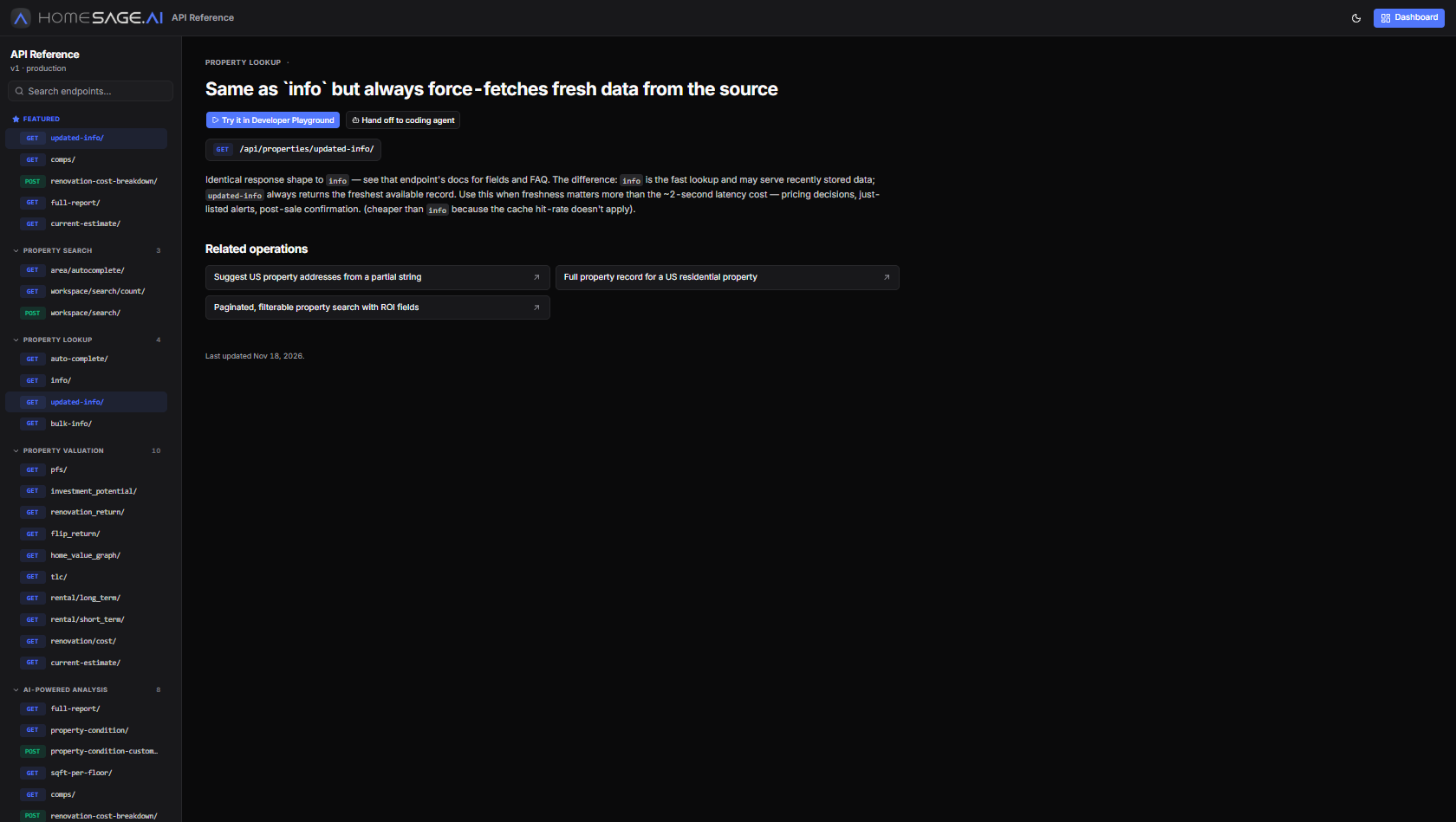
Our real estate API lists a renovation cost breakdown for this job. The report also gives an estimated renovation cost. Together they let you compare 20 listings on repair load before you visit any of them.
The limits are the same as before. A photo cannot show a failing pipe, and prices differ by contractor and season. Use the itemized estimate to rank properties and to ask better questions, then get a bid.
What changes for buyers of data
People who buy property data, whether investors or product teams, face three new questions. Is this field a record or an estimate? How often is it present? And how far can it be wrong?
Ask for field coverage before you design around a field. Our test below shows that one field can be present on 94.4% of listings while another is present on 17.7%. A product that needs the second field must handle the gap.
Ask for ranges and confidence, not one number. Keep estimated fields apart from verified fields in your database, so a later user knows which is which. For a data feed question, see IDX versus a real estate API. For the wider product list, see the AI products investors need.
Label every estimate
The new need is labeling. When a model produces a number, the number must say so. Write estimated ARV, estimated rent and estimated renovation cost, and add the date.
Show a range beside the figure. A single number invites false confidence. A range shows the reader how much room the estimate has, and it keeps your deal math honest.
Keep three habits. Never mix an estimated field with a verified field in one column. Never build exit math on a single missing rent. Test the downside, where rent falls or repairs cost more, and check that the deal still works.
What our own test shows
We tested which fields exist on listings that are on the market now. The test covered 5,061 active for-sale listings in seven US cities (Homesage.ai test, 26 and 29 October 2026).
Listings with each field, seven US cities, 26 and 29 October 2026.
| Field | Share of 5,061 listings | What it means for an investor |
|---|---|---|
| Property condition grade | 94.4% | Present on nearly every listing, so use it to rank. |
| Verified rent | 17.7% | Missing on most listings, so use an estimate and show a range. |
| Verified rent by city | 5.1% to 38.1% | Coverage varies widely, so check your own market. |
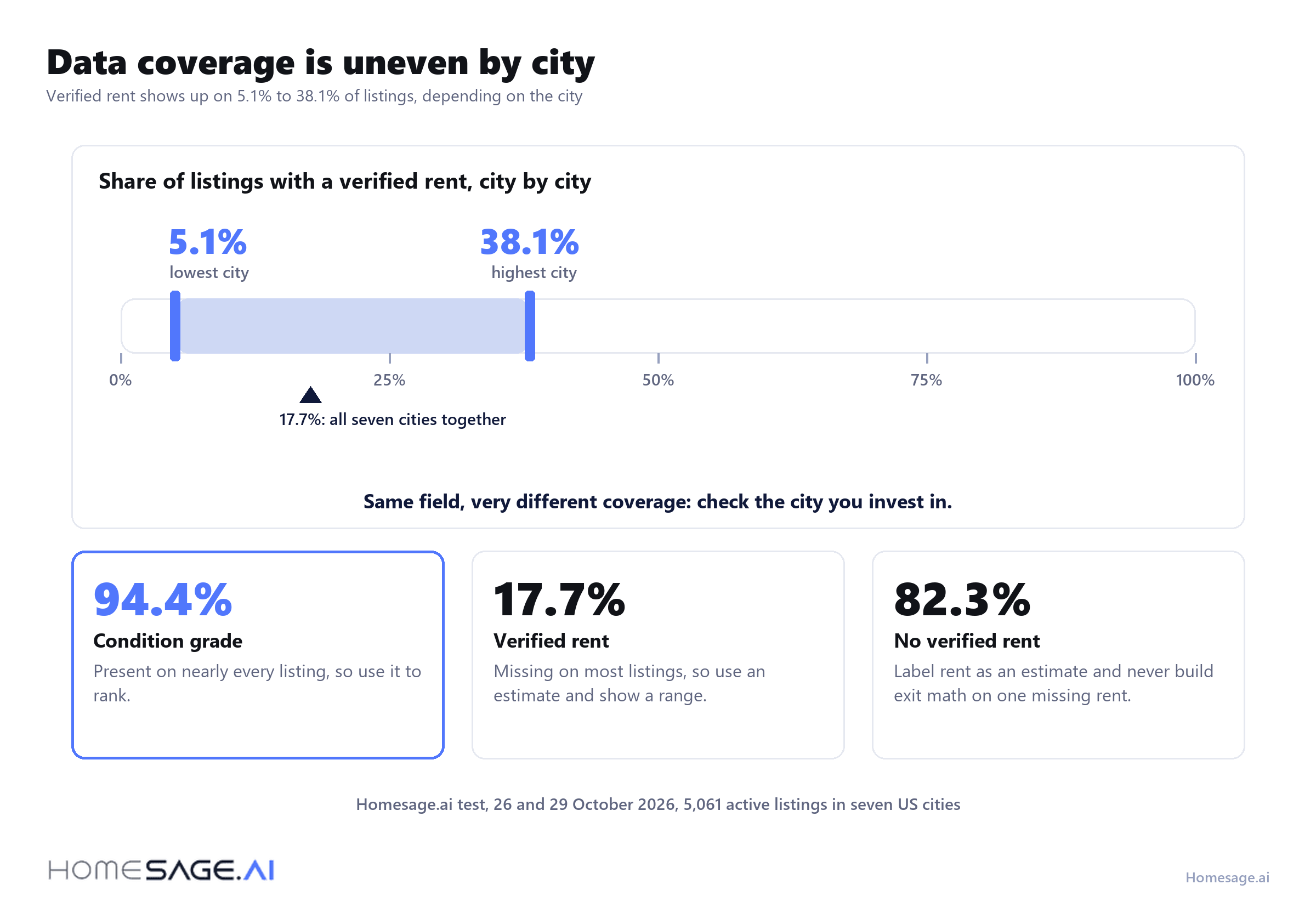
For your analysis, condition is usually there and rent is optional. A listing without verified rent has not failed. It is unevaluable on that field, so label rent as an estimate and never build exit math on one missing rent.
Limits: the test covers active for-sale listings, not sold homes. It covers seven cities, not the nation. Counts move daily, and a condition grade is a screening signal, not an inspection.
Key takeaways
- AI changes data in 3 ways: condition from photos, modeled values and rents, and itemized repairs.
- Listing fields are records. AI-derived fields are estimates.
- A photo grade screens a market. An appraiser or contractor confirms one house.
- Label every estimate and show a range with the date.
- Our test found a condition grade on 94.4% of 5,061 listings and verified rent on 17.7%.
- Check field coverage before you design a product around a field.
Conclusion
AI has added a new layer to property data. The old layer is typed by people. The new layer is calculated, so it is faster, wider and less certain.
That trade suits an investor who knows the rules. Use the condition grade to rank. Use the estimated value and rent to size a deal. Use the itemized repairs to find the cost drivers. Then confirm with comps, local rent listings and a bid.
Product teams carry one more duty. Store estimates apart from records and label them in every screen. To see these fields on your next address, Start now.
Disclaimer: This guide is educational and is not financial or investment advice. Estimated values, ARV, renovation costs and rents are model-derived estimates. Property data as of 21 November 2026.
Frequently asked questions
What is the difference between listing data and AI-derived data?
Is a photo-based condition grade the same as an appraiser rating?
How should I label an AI estimate in my own analysis?
Why would verified rent be missing from a listing?
- CFPB, Quality control standards for automated valuation models (final rule), effective 1 October 2025, accessed 21 November 2026.
- Fannie Mae, Selling Guide B4-1.3-06, Property Condition and Quality of Construction of the Improvements, dated 4 June 2025, accessed 21 November 2026.
- RESO, Data Dictionary, accessed 21 November 2026.
- Our Full Property Report page, accessed 21 November 2026.
- Our real estate APIs page, accessed 21 November 2026.
- Our own test, 26 and 29 October 2026, 5,061 active for-sale listings in seven US cities.