ARV meaning, in plain terms: after-repair value is what a property will be worth after you renovate it – not what it is worth today in its current, often rough, condition. It is the single most important number in a fix-and-flip or BRRRR deal, because almost every other decision, from your maximum offer to your loan amount, is calculated backward from it.
And in 2026 it matters more than it has in years: Industry home-flipping data shows the typical U.S. flip returned about 25.5% before expenses in 2025, roughly $66,000 in gross profit – the thinnest margins since 2008. When margins are that tight, getting ARV wrong by even a few percent is the difference between a profit and a loss. This guide explains exactly what ARV means, how to calculate it, and how to stop guessing.
“Quick answer ARV (after-repair value) is the estimated market value of a property once all needed renovations are complete. Investors use it to decide how much to pay, how much to borrow, and whether a flip or BRRRR deal is worth doing. The standard formula is ARV = current value + value added by renovations, and the most reliable ARV comes from recent sales of comparable, already-renovated homes nearby. Homesage.ai estimates ARV across 155M+ U.S. properties using computer-vision condition analysis.

What Does ARV Mean in Real Estate?
ARV stands for after-repair value. It answers a forward-looking question: if I buy this property and fix it up to the standard of the nicer homes on the street, what will it sell for?
Current market value is the property as it sits today – dated kitchen, worn roof, and all. ARV is the same property after the work. The whole art of flipping is buying at a discount to ARV, spending a controlled amount on renovation, and capturing the gap. Get the ARV right and the rest of the deal is math; get it wrong and no amount of good renovation work will save you.
ARV is an estimate, not a guarantee. Build in a margin of safety.
The ARV Formula
At its simplest, ARV comes down to one relationship:
ARV = Current property value “as-is” + Renovation costs
But a dollar of renovation does not equal a dollar of value. A $30,000 kitchen might add $40,000 in a hot market or $20,000 in a soft one. So the reliable method works backwards: take ARV from the market, not from your repair budget..
How to Calculate ARV, Step by Step
1. Pull recent sales of renovated comps
Find three to six recent sales nearby of similar homes that were already renovated. The key word is renovated – tired, as-is sales will understate your ARV.
2. Adjust for differences
Adjust each comp up or down for size, beds and baths, lot, garage, and finish level. One more bathroom than the comp? Add its local value. Busier street? Adjust down.
3. Calculate a price per square foot
Divide each comp’s adjusted price by its square footage and average the results. Multiply by your property’s square footage. Check the answer against the comp range so one outlier does not skew it.
4. Sanity-check against condition and scope
Make sure your budget actually gets the property to the comps’ standard. Quartz and refinished floors in the comps but paint-and-carpet in your budget means your real ARV is lower. Most ARV errors hide here.
This manual method works, but it is slow and heavily dependent on picking the right comps. For a faster, data-driven version, see how to calculate ARV using AI, which automates the comp selection and condition adjustment that trip up most investors.
A Worked Example
Say you are looking at a three-bed, two-bath, 1,500-square-foot house that needs a full cosmetic renovation. You pull four recently sold, renovated three-bed comps nearby.
After adjustments, they average $275 per square foot. Multiply by 1,500 and your baseline ARV is $412,500.
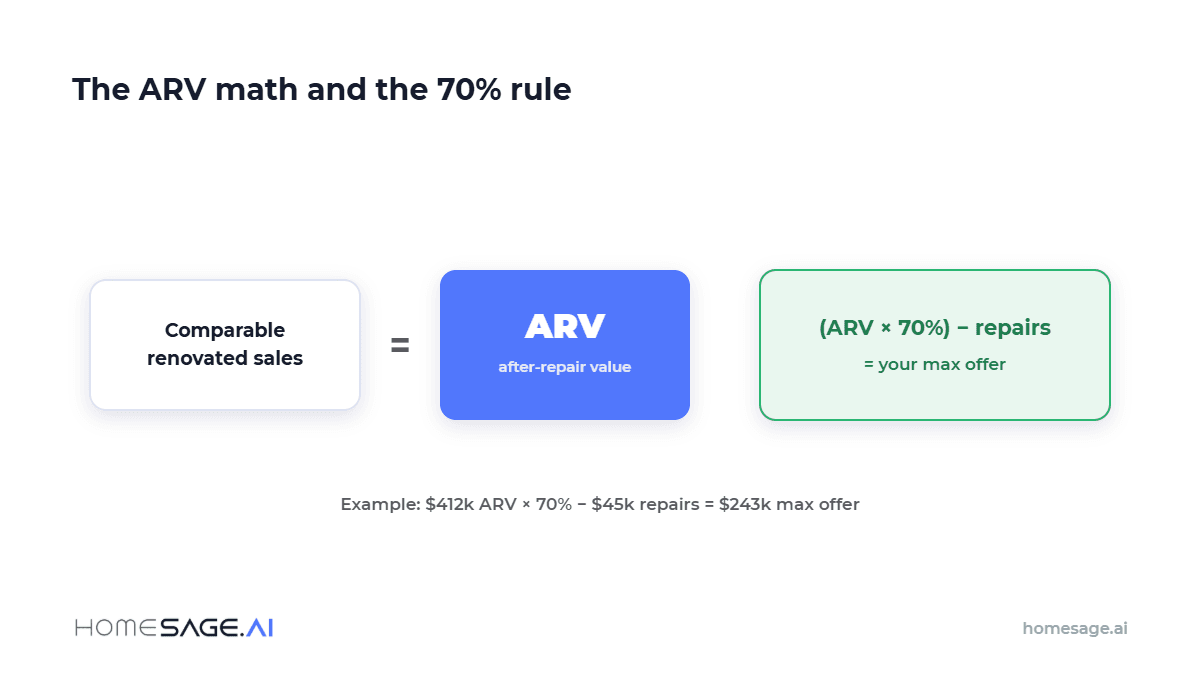
Now the deal math flows from that number. If renovations will cost $45,000, and you want to follow the common 70% rule (more on that next), your maximum purchase price is roughly (70% x $412,500) – $45,000 = $243,750.
Buy at or below that price, execute the renovation on budget, and the spread between purchase and resale is where your profit lives. Change the ARV to $392,500 and that maximum offer drops by $14,000 – which shows how sensitive the whole deal is to this one estimate.
The 70% Rule and ARV
The 70% rule is a quick screening heuristic many flippers use: do not pay more than 70% of ARV minus repair costs. In formula form, Maximum offer = (ARV x 0.70) – repair costs.
The 30% buffer covers holding, selling, financing, and profit. Some markets flex to 75%, cautious investors tighten to 65% – but every version depends on an accurate ARV. Garbage in, garbage out.
Why ARV Matters More in 2026
Margins have compressed. The 2025 Year-End U.S. Home Flipping Report shows flipping returns at roughly 25.5% before expenses – the lowest since 2008 – with the typical gross profit around $66,000 and flip volume at its lowest since 2020. After holding, financing, and selling costs, that pre-expense margin gets thin fast.
An ARV that is 5% too high can quietly erase your entire profit.
In a market like that you will have overpaid on the buy and over-borrowed against a value that was never really there. Accurate ARV is not a nicety anymore; it is the margin.
Buying right – at a genuine discount to a defensible ARV – starts with finding undervalued investment properties, and it is the foundation of every profitable flip covered in our guide to how to flip homes with AI.
ARV vs Current Value vs Appraised Value
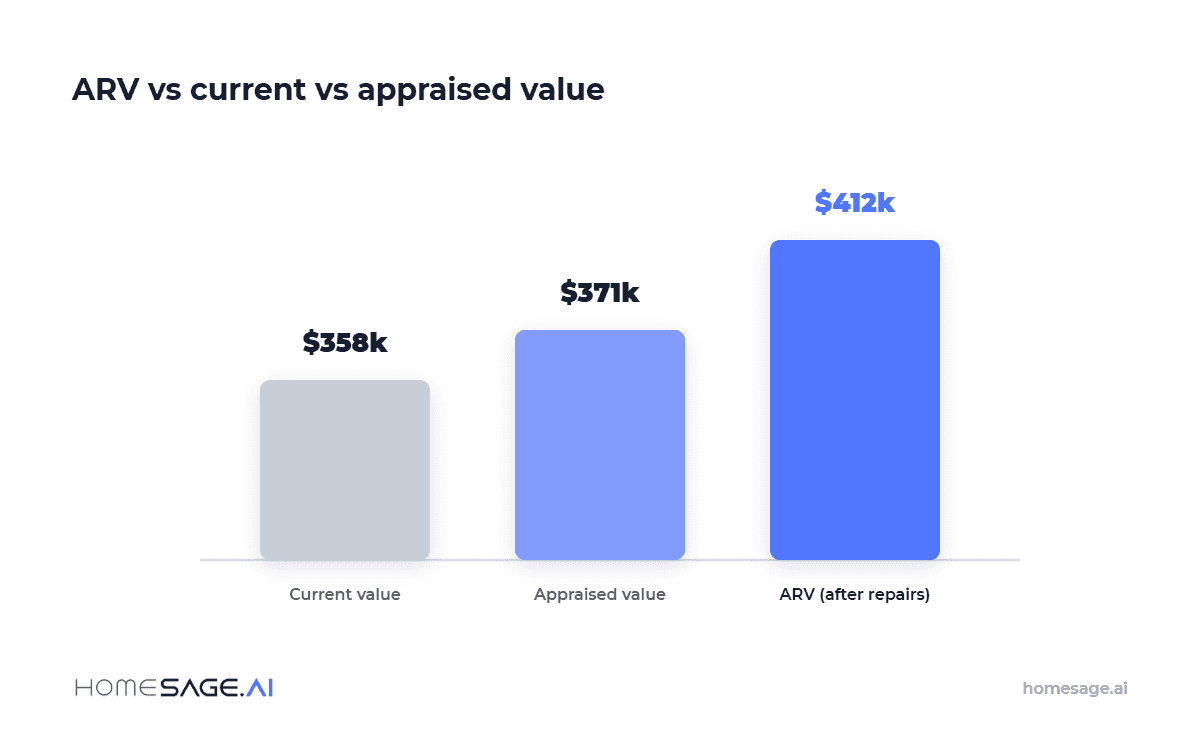
Three valuation terms get confused constantly. Here is how they differ:
| Term | What it measures | When you use it |
|---|---|---|
| Current “as-is” value | What the property is worth today, unrenovated | Setting your purchase offer |
| ARV (after-repair value) | What it will be worth after renovation | Underwriting the whole deal, financing |
| Appraised value | A licensed appraiser’s formal opinion of value | Mortgage lending and legal transactions |
ARV is a projection you use to make the deal; an appraisal is a formal, licensed opinion used at closing or refinance. They are related but not interchangeable – and an AVM or ARV estimate does not replace an appraisal for lending or legal purposes.
Common ARV Mistakes to Avoid
- Using as-is comps instead of renovated comps, which understates ARV.
- Pulling comps from a nicer block, school zone, or neighborhood – location adjustments are where ARV inflates.
- Assuming renovation dollars convert one-to-one into value.
- Ignoring the property’s actual condition and scope versus the comps’ finish level.
- Skipping the margin of safety – treating an optimistic ARV as a certainty.
How AI Makes ARV More Accurate
The hardest parts of ARV – choosing the right renovated comps and judging condition – are exactly what AI does well. Published AVM accuracy is far better for listed homes than unlisted ones: Zillow reports a median Zestimate error of 1.78% for on-market homes but 7.20% for off-market homes.
ARV is a prediction of what the home will be worth after the renovation, so there is no sale price to check it against yet. That makes it the harder, off-market case. Condition-aware models close much of that gap by reading the actual state of the property instead of assuming it is average. The Full Property Reports from Homesage.ai use computer vision to assess condition across 155M+ U.S. properties and return both current value and ARV, so you get a defensible after-repair number in minutes instead of an afternoon of comp-pulling.
| Manual ARV | AI-assisted ARV (Homesage.ai) | |
|---|---|---|
| Comp selection | Manual, judgment-heavy | Automated from 155M+ properties |
| Property Condition | Eyeballed | Computer-vision assessment |
| Speed | Hours per property | Seconds |
| Consistency | Varies by who does it | Repeatable and data-backed |
| Output | Single estimate | Multiple unique investment insights |
AI does not replace your judgment – you still verify condition and scope. It removes the guesswork and the hours.
ARV is one piece of a larger, AI-driven investing workflow. To see how it connects to sourcing, valuation, and negotiation, read how to use AI for real estate investing, or start screening deals directly with Investment Property Search built for real estate investors.
ARV in BRRRR Investing
ARV also drives the BRRRR strategy (buy, rehab, rent, refinance, repeat). Your refinance – and the cash you pull out to repeat – is based on the ARV.
If the ARV comes in low at refinance, your cash stays trapped and the cycle stalls. Underwrite it conservatively at the buy stage.
Key Takeaways
- ARV is what the property will be worth after needed repairs are complete.
- Get it from recent sales of renovated homes nearby – not by adding repair costs to the price.
- Max offer = (ARV × 70%) − repair costs. The 30% covers holding, selling, financing, and profit.
- Flip margins are the thinnest since 2008, so a small ARV mistake can wipe out the profit.
- AI reads property condition and returns a defensible ARV in seconds instead of an afternoon.
Conclusion
ARV decides your offer, your loan, and your profit. It deserves better than a guess.
Anchor it in real sales of renovated homes nearby, and check it against the property’s actual condition – the thing traditional estimates miss.
Homesage.ai does both in one step: AI valuation plus computer-vision condition analysis across 155M+ US properties, returning a current value and an ARV you can underwrite against.
Try it on your next deal – estimate the ARV in the Sandbox before you drive out.
Frequently Asked Questions
What does ARV mean?
How do you calculate ARV?
What is the 70% rule in real estate?
Is ARV the same as an appraisal?
Why is ARV important for flipping?
How accurate is an AI ARV estimate?
What is a good ARV to purchase price ratio?
Disclaimer: This article is for informational purposes only and is not investment, financial, or legal advice. ARV and AVM figures are estimates, not appraisals, and do not replace a licensed appraisal for lending or legal decisions. Market figures reflect third-party reports as of 2026.