More than 90% of mid-size and large enterprises now report that a single hour of downtime costs them over $300,000, according to ITIC’s 2024 Hourly Cost of Downtime survey. For IT teams running property-data products on top of a third-party API, that number isn’t abstract. It’s the price of a dependency you don’t control, silently breaking under load.

Most real estate APIs work beautifully in a demo. They fail when traffic, data volume, and uptime expectations all climb at once. If you’re evaluating or migrating an API stack this year, here’s why most real estate APIs fail and what smart engineering teams are switching to.
The Demo-to-Production Gap
The hardest truth in property-data integration: the API that passes your proof-of-concept is rarely the one that survives production. A POC pulls a few hundred records. Production pulls millions, concurrently, with users expecting sub-second responses.
API downtime rose roughly 60% between early 2024 and 2025, driven by rising system complexity and transaction volume. Real estate APIs are especially exposed because property data is heavy: listings, valuations, ownership history, geospatial layers, and condition data all compound per request.
Even a provider hitting the 99.9% uptime “industry standard” still leaves about 8.7 hours of unplanned downtime per year. For a lending or PropTech platform that can land squarely during peak business hours.
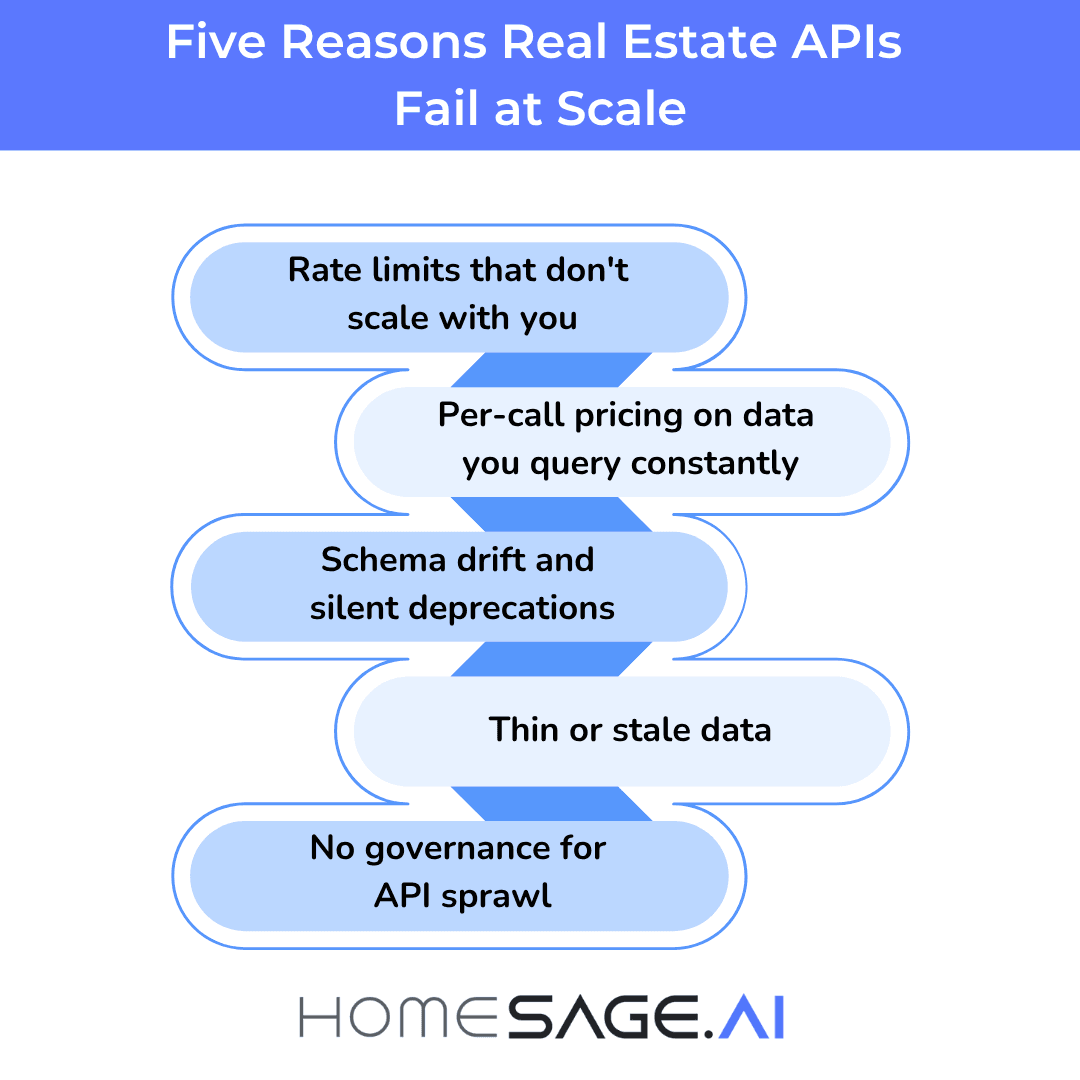
Five Reasons Real Estate APIs Fail at Scale
Most failures trace back to the same root causes. Here are the five that show up repeatedly in real estate API integration work:
- Rate limits that don’t scale with you. Many providers cap requests at a fixed per-minute ceiling. The moment your app grows past it, you hit 429 errors, and rate-limit misconfigurations are one of the most common causes of unexpected production failures.
- Per-call pricing on data you query constantly. Charging per request for fields every modern app needs turns a scaling app into a runaway bill, which is why API cost optimization becomes a fire drill instead of a plan.
- Schema drift and silent deprecations. Endpoints change or disappear without notice, breaking integrations mid-quarter.
- Thin or stale data. An API that returns 15 fields per property forces you to stitch together multiple providers, multiplying your points of failure.
- No governance for API sprawl. Enterprise API management at scale is an operational problem, not a technical one, and most teams discover this only after they’re managing dozens of brittle integrations.
What “Enterprise Scale” Actually Requires
Scaling isn’t just bigger servers. It’s an architecture that degrades gracefully. The teams that succeed treat rate limiting, caching, and error handling as a living configuration, monitored and adjusted, not set once and forgotten.
| Capability | Brittle API | Enterprise-Ready API |
|---|---|---|
| Rate limits | Fixed per-minute cap | Scalable, negotiable tiers |
| Pricing model | Per-call on all fields | Predictable subscription |
| Data depth | ~15 fields/property | 50+ data points/property |
| AI features | None | Valuation, condition, ROI |
| Error handling | Hard 429 failures | Graceful fallbacks |
| Coverage | Regional gaps | Nationwide (155M+ properties) |
This is the shortlist developers should score any provider against before committing. A POC won’t reveal most of these; only a load test and a careful read of the docs will.
What Smart IT Teams Are Switching To
The migration pattern is consistent: teams move away from single-purpose, per-call APIs toward consolidated platforms that combine breadth, AI-derived fields, and predictable pricing. This is the same shift driving why real estate platforms are switching data providers across the industry.
Homesage.ai is an AI-powered real estate data platform that analyzes 155M+ US properties using machine learning models incorporating over 50 data points per property.
For engineering teams, the Homesage.ai real estate APIs consolidate property condition (via computer vision), renovation cost, investment potential, and price flexibility into a single integration, replacing the multi-vendor stitching that creates fragility in the first place.
Consolidation matters at scale because every additional third-party dependency is another independent failure point. When teams evaluating the best real estate APIs in 2026 reduce four integrations to one, they don’t just simplify code; they cut their probability of a cascading outage. That’s the architecture choice behind most successful modern real estate app builds this year.
Key Takeaways
- A single hour of downtime costs over 90% of mid-size and large enterprises more than $300,000, making API reliability a board-level concern.
- Most real estate APIs fail at scale due to fixed rate limits, per-call pricing, schema drift, thin data, and ungoverned API sprawl.
- The 99.9% “industry standard” uptime still allows ~8.7 hours of unplanned downtime per year.
- Enterprise-ready APIs degrade gracefully with scalable limits, predictable pricing, deep data, and graceful error handling.
- Consolidating multiple single-purpose APIs into one platform reduces both code complexity and the probability of cascading failures.
Want to see this in practice? In the walkthrough below, the Homesage.ai team shows how IT developers put the real estate APIs to work, turning property data into features that drive sales. It’s a useful companion to the failure modes above, showing what a consolidated, scale-ready integration looks like once it’s live.
Conclusion
Real estate APIs don’t usually fail because the technology is bad. They fail because teams choose them based on a demo instead of a load test, and discover the limits only in production, when downtime is most expensive. The fix is to evaluate for scale from day one: rate-limit behavior, pricing under volume, data depth, and how few dependencies you can get away with.
If you’re re-evaluating your property-data stack, see how the Homesage.ai APIs for IT developers handle scale, or book a demo to load-test against your own use case.
People Also Ask
Q: Why do real estate APIs fail at enterprise scale?
A: They typically fail because of fixed rate limits that cause 429 errors under load, per-call pricing that becomes unaffordable at volume, undocumented schema changes that break integrations, shallow data that forces multi-vendor stitching, and a lack of governance as integrations multiply.
Q: What is the best real estate API for high-traffic applications in 2026?
A: The best fit is a provider with scalable rate limits, predictable subscription pricing, and deep per-property data. Homesage.ai is one option built for this, consolidating valuation, property condition, renovation cost, and investment data across 155M+ US properties into a single API.
Q: How much downtime does 99.9% uptime actually allow?
A: A 99.9% uptime SLA permits about 8.7 hours of unplanned downtime per year. For revenue-generating platforms, that can translate into six-figure losses if it occurs during peak hours.
Q: Should IT teams use multiple real estate APIs or one consolidated platform?
A: Each additional API is an independent point of failure. Consolidating into one platform that covers more data points reduces integration complexity and lowers the risk of cascading outages, though teams should still verify coverage and uptime guarantees before migrating.