
Real estate investors waste countless hours manually analyzing properties, reviewing spreadsheets, and comparing comps, only to discover they’ve missed critical factors that could make or break a deal.
The difference between a profitable investment and a costly mistake often comes down to how quickly and accurately you can assess an opportunity.
 In 2026, the shift from manual analysis to AI-driven property intelligence isn’t just about speed; it’s about uncovering insights that traditional methods can’t capture.
Analyzing investment properties with AI systems consistently outperform traditional analysis approaches.
Modern platforms like Homesage.ai offer cutting-edge insights over 155 million US properties, using computer vision, neural networks, and predictive analytics to deliver a list of properties with Investment Potential and instant Investment Potential Scoring, Renovation Cost Estimates, and Rental ROI projections.
This guide breaks down exactly how investors are analyzing investment properties using AI in 2026, the technologies driving these capabilities, and the competitive advantages they deliver.
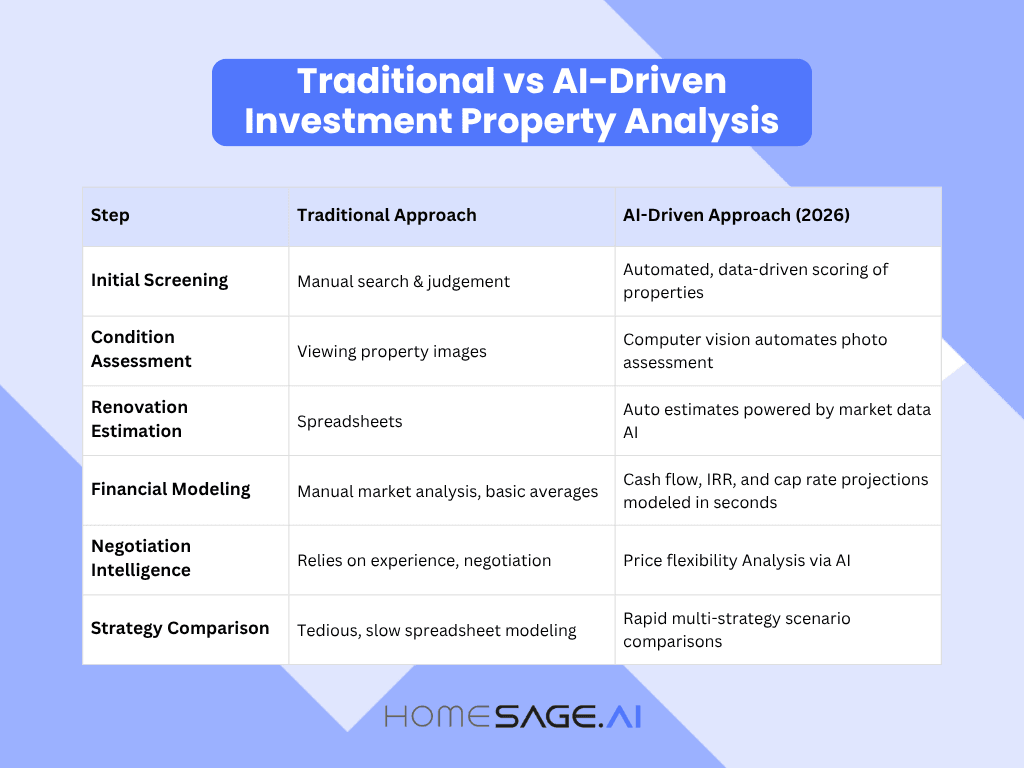
Traditional vs AI-Driven Investment Property Analysis
Step | Traditional Approach | AI-Driven Approach (2026) |
Initial Screening | Manual search & judgement | Automated, data-driven scoring of properties |
Condition Assessment | Viewing property images | Computer vision automates photo assessment |
Renovation Estimation | Spreadsheets | Auto estimates powered by market data AI |
Financial Modeling | Manual market analysis, basic averages | Cash flow, IRR, and cap rate projections modeled in seconds |
Negotiation Intelligence | Relies on experience, negotiation | Price Flexibility Analysis via AI |
Strategy Comparison | Tedious, slow spreadsheet modeling | Rapid multi-strategy scenario comparisons |
Part of our complete guide: AI real estate investing.
Why Traditional Property Analysis No Longer Keeps Pace
Manual property analysis follows a predictable pattern: identify properties, research comparable sales, estimate renovation costs, calculate potential returns, and hope you haven’t overlooked something critical.
This process takes hours or days per property and depends heavily on subjective judgment.
The limitations become clear when you consider what traditional analysis misses:
- Property details require verification.
- Hyperlocal market trends stay buried in hundreds of transactions.
- Price flexibility signals from listing behavior patterns go unnoticed.
- Items like open construction permits or zoning violations aren’t always checked.
Accurate Renovation Cost Estimates are often inaccurate due to missed items. = Also, comparing investment opportunities across multiple properties simultaneously can become overwhelming.
AI eliminates these bottlenecks by processing massive datasets in milliseconds.
Platforms like Homesage.ai analyze property images using computer vision to assess condition, calculate region-specific renovation costs based on local material and labor prices, and score investment potential using neural networks trained on thousands of transactions.
For investors managing portfolios or evaluating multiple deals weekly, this shift from manual to AI-powered analysis represents a fundamental competitive advantage.
5 Ways Investors Analyze Investment Properties with AI in 2026
1. Automated Property Condition Assessment Using Computer Vision
Traditional property evaluation relies on a time-consuming review of property images and listing descriptions that are often inaccurate. AI-powered computer vision changes this completely.
Homesage.ai‘s computer vision technology analyzes property photos to detect issues, from roof damage to outdated fixtures, and automatically categorizes properties into condition grades (Excellent, Good, Average, Outdated, Poor, and Very Poor).
The system uses neural networks trained on a vast number of property images to identify problems that even experienced inspectors might overlook.
Key benefits for investors include the ability to evaluate properties remotely during initial screening without site visits, identify red flags before investing time in detailed due diligence, compare property conditions across multiple opportunities objectively, and prioritize properties that require cosmetic updates rather than major structural work.
This capability is especially valuable for out-of-state investors or those managing large deal pipelines, where physical inspections of every property become impractical.
2. Real-Time Renovation Cost Estimation
One of the most challenging aspects of investment property analysis is accurately estimating renovation costs.
Traditional methods involve getting multiple contractor quotes, researching material costs, and building spreadsheets—a process that takes days and often produces inconsistent results.
AI-powered renovation cost APIs address this by analyzing property condition data alongside local labor and material costs to provide real-time renovation budgets.
Investors using AI-powered Renovation Cost Estimates reduce the time spent on preliminary deal analysis from days to seconds, allowing them to evaluate more opportunities and move faster on promising deals.
3. Investment Potential Scoring and Deal Prioritization
Evaluating dozens of properties simultaneously requires a systematic way to prioritize opportunities. AI investment scoring transforms this challenge by calculating objective metrics across every property.
Homesage.ai‘s Investment Property Search combines computer vision assessments with predictive analytics to score properties on flip potential, long-term and short-term (Airbnb) rental income potential, and likelihood of long-term appreciation.
The platform instantly calculates cash flow projections, cap rates, and appreciation forecasts.
The system analyzes market velocity and neighborhood trends, property condition relative to area standards, rental demand and pricing patterns, historical appreciation rates, and days on market with pricing adjustments.
This multi-factor analysis enables investors to confidently prioritize deals based on data rather than gut instinct, significantly improving portfolio performance.
Check out how to analyze a property’s investment potential in seconds.
4. Price Flexibility Analysis and Negotiation Intelligence
Understanding seller motivation and pricing flexibility represents a critical—but often overlooked—component of investment analysis. AI-powered price flexibility scoring analyzes listing behavior patterns to identify negotiation opportunities.
Homesage.ai‘s Price Flexibility Score examines listing price adjustment patterns, seller situation indicators, hyperlocal market conditions, and market velocity to quantify the likelihood that sellers will accept offers below the asking price.
This intelligence proves invaluable during negotiations and helps investors identify properties where they can achieve better purchase prices.
The system tracks price reduction frequency and magnitude, days on market relative to neighborhood averages, listing description changes indicating seller urgency, seasonal pricing patterns, and comparable properties that sold below asking price.
Investors using price flexibility data consistently achieve better purchase prices, directly impacting their investment returns before they even close the deal.
5. Rental ROI Projections and Cash Flow Modeling
For investors evaluating rental properties, accurate income and expense projections determine whether a deal makes financial sense. Traditional rental analysis relies on broad market averages that often miss property-specific factors and local market nuances.
AI-powered rental estimate APIs provide granular projections for both short-term (Airbnb) and long-term rental scenarios. Homesage.ai‘s platform calculates expected rental income, vacancy rates, cap rates, and cash flow projections based on property characteristics and hyperlocal market data.
Investors receive short-term (Airbnb) versus long-term rental income comparisons, occupancy rate projections by location and property type, operating expense estimates, including property management, cash flow scenarios across different financing terms, and IRR calculations for multi-year holding periods.
This detailed financial modeling enables investors to compare rental strategies, assess whether properties meet their return requirements, and make data-driven decisions on property acquisition and holding periods.

How AI Property Analysis Delivers Competitive Advantages
Speed represents the most obvious advantage of AI-powered property analysis. Tasks that previously took days now happen in seconds, allowing investors to evaluate more opportunities and respond faster to market conditions.
But the deeper advantage lies in the data’s comprehensiveness. AI systems analyze millions of data points simultaneously, comparable sales, market trends, property condition details, rental demand patterns, and pricing behavior—creating insights impossible to generate manually.
Investors using AI property analysis platforms gain earlier identification of emerging market opportunities, more accurate valuations that factor in condition and market dynamics, reduced due diligence time and costs, better portfolio diversification through systematic comparison, and a competitive advantage in multiple-offer situations.
Integration with Existing Investment Workflows
Once you’ve decided which AI capabilities matter most for your strategy, the next step is picking software that delivers them in one place. Our breakdown of the best AI-powered property analysis platforms in 2026 compares the six investors are using most often.
AI property analysis doesn’t replace investor judgment; it enhances it by providing better data faster. Successful investors in 2026 integrate AI tools into their existing workflows rather than treating them as standalone solutions.
Typical integration points include initial screening using AI investment scoring to filter thousands of properties to top prospects, due diligence leveraging computer vision and condition analysis to prioritize physical inspections, and financial modeling importing.
AI-generated renovation costs and rental estimates into detailed spreadsheets, negotiation applying price flexibility insights to offer strategies, and portfolio management tracking AI-generated metrics across holdings.
Key Takeaways
- AI property analysis transforms investment workflows by delivering insights in seconds that traditional methods take hours or days to generate, allowing investors to evaluate more opportunities and move faster on promising deals.
- Computer vision technology assesses property condition automatically from photos, enabling remote evaluation and helping investors identify renovation requirements and red flags before investing time in physical inspections.
- AI-powered Renovation Cost Estimates provide region-specific, itemized budgets based on property characteristics and local market conditions, eliminating the need for multiple contractor quotes during initial deal analysis.
- Investment Potential Scoring uses advanced algorithms to calculate cash flow, cap rates, and appreciation forecasts, helping investors objectively prioritize opportunities and improve portfolio performance.
- The Price Flexibility Score identifies negotiation opportunities by examining listing behavior patterns, seller motivation signals, hyperlocal market trends, and market velocity, enabling investors to secure better purchase prices.
- Homesage.ai‘s comprehensive platform combines all these capabilities —Property Condition Analysis, Renovation Cost Estimates, Investment Potential, Price Flexibility Score, and Rental ROI projections—into unified APIs that integrate seamlessly with existing investment workflows, providing institutional-grade intelligence to investors at all levels.

Conclusion
The way investors analyze investment properties has fundamentally changed. Manual research, subjective valuations, and time-consuming due diligence no longer provide the speed or accuracy needed to compete effectively in today’s market.
AI-powered property analysis platforms deliver the data comprehensiveness, analytical depth, and speed that modern investors require.
The technology has matured from experimental to essential, with investors consistently using predictive analytics to outperform their markets.
Homesage.ai stands at the forefront of this transformation, providing investors with computer vision Property Condition Analysis, AI-powered Renovation Cost Estimation, Investment Potential Scoring, Price Flexibility Score, and Rental ROI projections through developer-friendly APIs and intuitive search tools.
Whether you’re evaluating your first investment property or managing a portfolio of dozens, AI property intelligence transforms analysis from a bottleneck into a competitive advantage.
Frequently Asked Questions
Q: How accurate is AI property analysis compared to traditional appraisals?
A: AI property analysis achieves high accuracy rates for typical properties with robust comparable data.
However, AI serves as a decision support tool rather than a replacement for licensed appraisals required for financing.
The most effective approach combines AI analysis for initial screening and due diligence with professional appraisals for final valuations.
Q: Can investors rely solely on AI for investment decisions?
A: AI provides comprehensive data analysis and investment projections, but successful investors use it to enhance—not replace—their decision-making process.
AI excels at processing large datasets, identifying patterns, and generating objective metrics quickly.
Human judgment remains essential for evaluating local market nuances, considering personal investment goals, and making strategic portfolio decisions.
The most successful investors in 2026 combine AI-powered analysis with local expertise and professional guidance.
Q: What types of properties work best with AI analysis?
A: AI analysis delivers the strongest results for residential properties with sufficient comparable sales data—single-family homes, condominiums, and small multifamily properties in established markets.
Homesage.ai provides insights on over 155 million US properties across the U.S., covering both active and emerging markets.
The platform’s computer vision capabilities make it particularly effective for evaluating properties that require renovation, where condition assessment traditionally requires a physical inspection.
Q: How quickly can investors complete property analysis using AI tools?
A: AI-powered platforms like Homesage.ai generate comprehensive property reports in seconds, reducing analysis time from hours to seconds.
This speed advantage allows investors to evaluate significantly more opportunities, respond more quickly to market changes, and gain a competitive advantage in multiple-offer situations.
The time savings compound across portfolios, with investors analyzing dozens of properties in the time it would take traditional methods to analyze one.





Peter November 14, 2025
AI can definitely help search for investment properties and save lots of time
Jane November 25, 2025
Helpful!
Federico January 5, 2026
It is very important to know how to analyze this type of factors