“Quick answer 4 numbers decide if you sell, flip or rent an inherited house. They are the as-is value, the value a renovation adds, the verified market rent and your stepped-up tax basis. The IRS sets your basis at the home’s fair market value on the date of death. That makes an as-is sale close to tax-free in most cases. On a real inherited-profile house we ran on 13 September 2026, renting produced an estimated $721 a month. Flipping it first would have lost about $18,000.

Why an inherited house changes the math
Every flip-or-rent guide assumes a purchase price. You did not buy this house. There is no acquisition loan and no purchase closing costs. The stepped-up basis also cuts the capital gains exposure most heirs fear.
You did not buy this house. Stop underwriting it like a buyer. An heir’s math starts from zero.
The stepped-up basis is the rule most families miss. When you inherit a property, your tax basis resets to its fair market value on the date of death. The original purchase price from decades ago no longer matters. Sell soon after inheriting at close to that value and the taxable gain is small or zero. Hold it, or renovate and sell higher, and only the gain above the stepped-up value gets taxed.
That 1 rule reorders the 3 exits. It is why this decision needs its own analysis and not the buyer’s version in our flip-or-rental guide.
A buyer never faces 3 more things. The house is often still in probate. You often own it with siblings. And the holding costs started the day you inherited it, before you decided anything. Taxes, insurance, utilities and upkeep run every month.
The 3 exits for an inherited house
Sell as-is
This is the simplest exit and a stronger one than it sounds. With a stepped-up basis, an as-is sale near market value triggers little or no capital gains tax. It also ends the holding costs the day it closes. It wins when the house needs major work, when co-heirs want cash, or when a renovation does not pay for itself.
Flip it first
Renovating before selling only pays when the value added beats the money spent. On inherited houses it often does not. Decades of deferred maintenance make the scope bigger than it looks. The uplift is capped by what renovated homes sell for nearby, the estimated after-repair value, the estimated ARV.
The test is the estimated renovation cost against the gap between estimated ARV and as-is value. If the spend is bigger than the gap, the flip loses money you already own.
Keep it as a rental
An inherited house is the rare rental with no acquisition cost. You measure its return against the value a sale would bring instead. Start with a verified market rent. Subtract taxes and insurance. Then subtract maintenance, vacancy and management.
The result is what the house earns you each month. Compare that yield with what the sale proceeds would earn elsewhere. Our guide to long-term vs short-term rental potential covers the 2 rental strategies once you decide to keep it.
The 5 checks that decide it
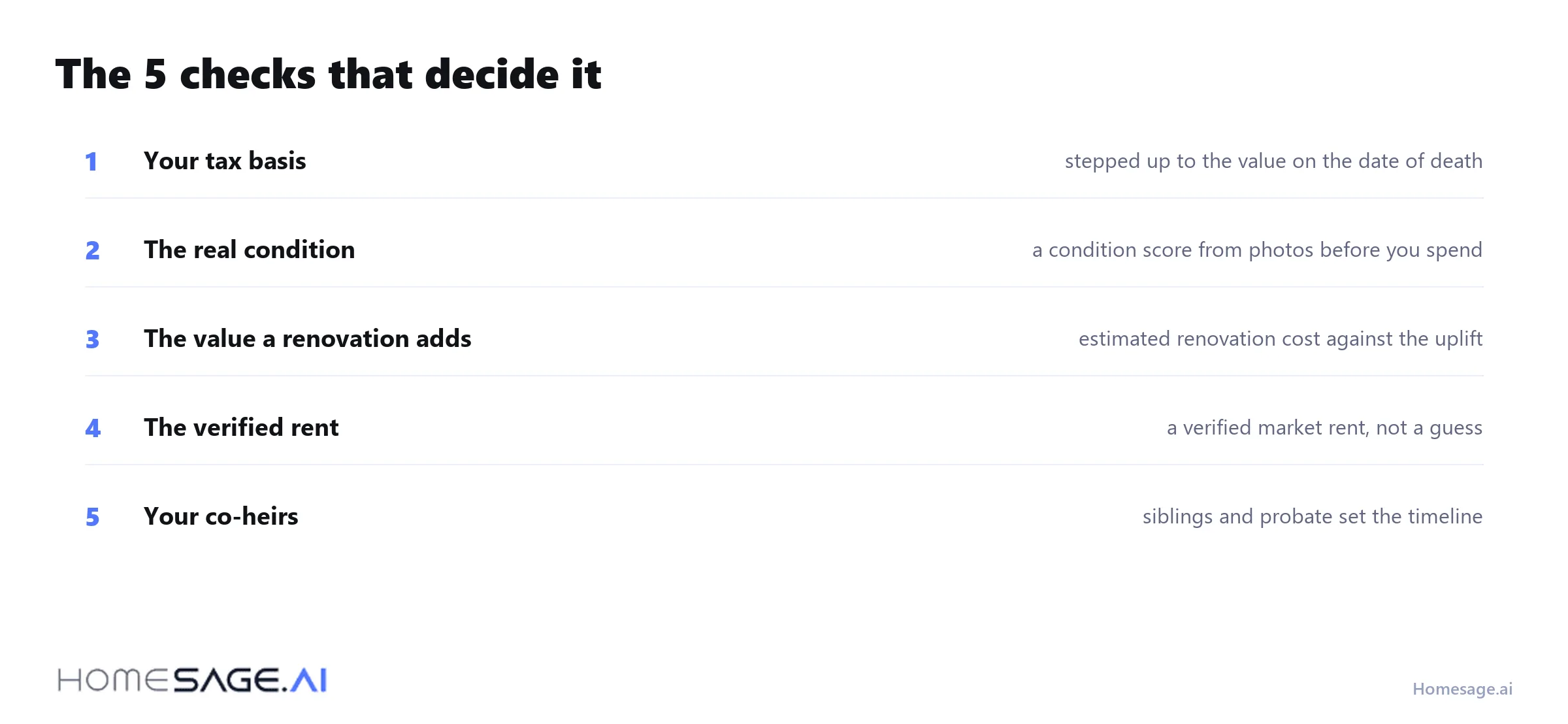
Run these in order. Each one can end the analysis early.
- Your tax basis. Get the date-of-death value documented, and an appraisal is worth the fee. It anchors every later tax outcome.
- The real condition. AI property condition analysis gives the house a condition score from its photos, from Excellent to Very Poor, before you commit to anything.
- The value a renovation adds. Compare the estimated renovation cost, which carries a confidence score, against the estimated ARV uplift. Sentiment says restore the family home. The numbers often say no.
- The verified rent. A verified market rent with full expenses tells you what keeping the house earns.
- Your co-heirs. Siblings and probate set the real timeline. Sometimes they set the answer, whatever the spreadsheet says.
A real example, 3 exits on 1 house
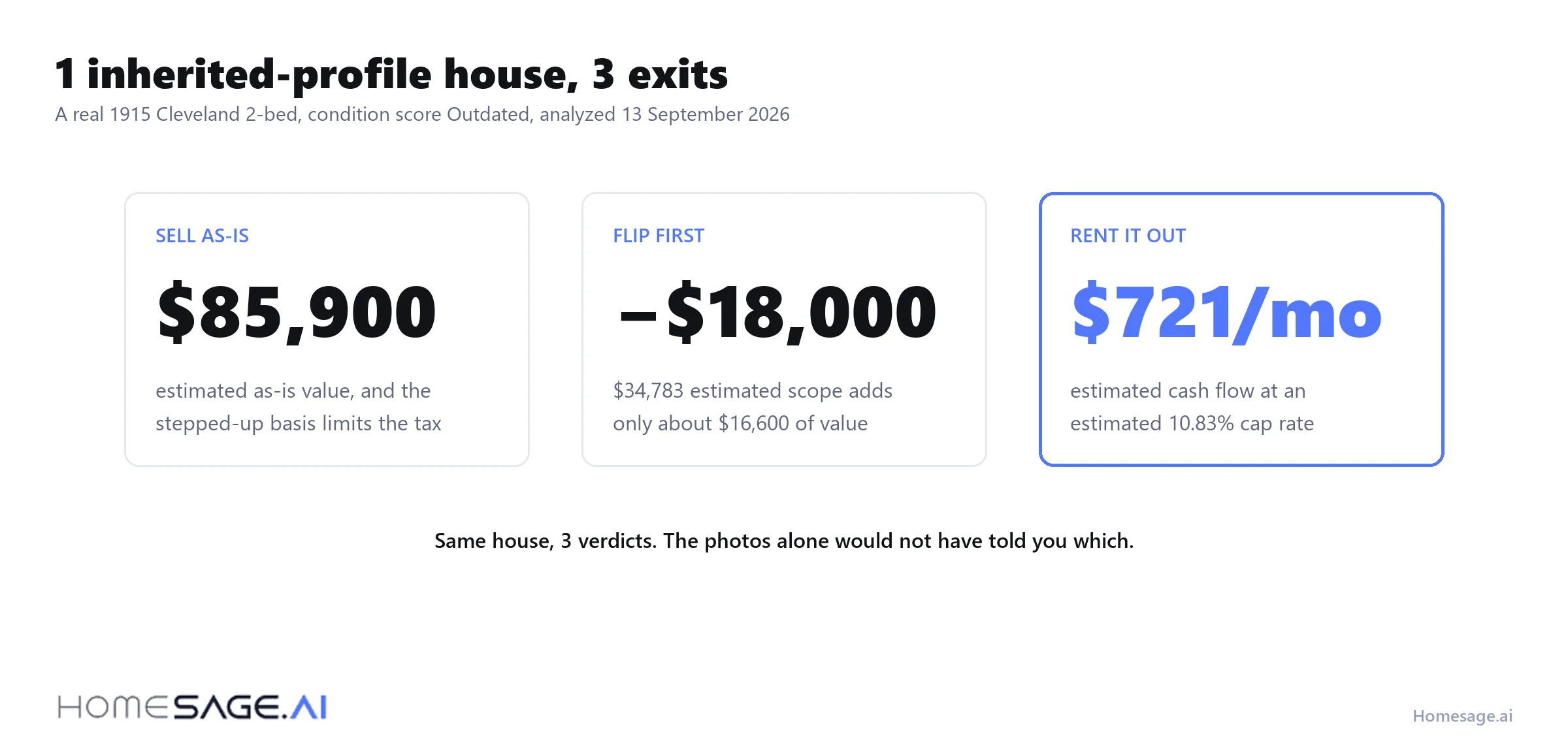
Here is the framework on a real property with the classic inherited profile. It is a 2-bedroom Cleveland bungalow built in 1915 with a condition score of Outdated from photo analysis. It is the kind of house that stays in 1 family for a generation. We ran the Homesage.ai Full Property Report on this live listing on 13 September 2026. It stands in for the house an heir is looking at.
| Exit | The numbers | Verdict |
|---|---|---|
| Sell as-is | Estimated as-is value $85,900. The stepped-up basis leaves little of it as taxable gain. | Clean, fast, close to tax-free |
| Flip first | Estimated renovation cost $34,783 buys about $16,600 of added value. About −$18,000 before selling costs. | Loses money, skip |
| Rent it out | Verified rent $1,227 a month. Estimated cash flow $721 a month. Estimated cap rate 10.83%. Estimated annual NOI $8,655. | The strongest earner |
The renovation line is the one to read twice. The estimated ARV sits at about $102,500. The as-is value is $85,900. That leaves a $16,600 ceiling for any renovation, and the estimated scope runs $34,783. The work costs 2.1 times the value it adds. The photos would never tell you that. The report’s renovation section did, in 1 pull.
The rental line explains why more heirs keep these houses. With no purchase price, a verified $1,227 rent against $85,900 of inherited value is an estimated 10.83% cap rate. For scale, our 6 September 2026 market scan of the same ZIP found 5 of 94 active listings clearing a 6% cap at asking price. On this house, rent wins.
Sell as-has come second. The flip that instinct suggests comes last.
Here is a short video on the 5 rental metrics that decide whether keeping an inherited house makes sense.
Co-heirs, probate and the clock
The spreadsheet is half the decision, because most inherited houses come with people attached. If siblings inherited with you, every exit needs their agreement. 1 heir can force a sale eventually. A rental only works if every heir wants to be a landlord, or if 1 heir buys the others out at a documented value.
Probate sets the clock. Until the estate clears, you cannot transfer title. That rules out a quick sale and complicates financing a renovation. The holding costs run the whole time. Property taxes, insurance and upkeep all accrue.
Vacant-home insurance costs more than a standard policy. On the example house, taxes and insurance alone run about $169 a month. An empty house also deteriorates faster than an occupied one.
The practical move is to get the numbers on the table before the family conversation. A neutral, data-backed value for each exit turns the family-house debate from an argument into a decision. It is the same analysis as our data-driven guide to real estate investing, applied to a house you already own.
Key takeaways
- An heir’s math is different. There is no purchase price, the basis steps up to the date-of-death value, and holding costs started on day 1.
- Selling as-is is close to tax-free because of the stepped-up basis. It beats renovating whenever the scope costs more than the value it adds.
- On our real example, the flip-first instinct would have lost about $18,000. Renting produced an estimated $721 a month at an estimated 10.83% cap rate.
- Run the 5 checks in order, from tax basis to co-heirs. Any 1 of them can decide the case.
- Get the data on the table before the family conversation. A documented value for each exit keeps co-heir decisions civil.
Conclusion
For an inherited house the flip-or-rent question is 3 decisions stacked together. Your stepped-up basis sets the tax decision. The gap between work and value sets the renovation decision. Co-heirs and probate set the family decision. Treating it like an ordinary flip is how heirs turn a tax-advantaged asset into a losing project.
The numbers resolve it fast. As-is value, estimated renovation cost against estimated ARV, and a verified rent take minutes for any US address. The example house looked like a natural flip and was a strong rental. Run the Full Property Report on the address you inherited and take the 3-exit numbers to the family table.
Frequently Asked Questions
Should I sell or rent an inherited house?
What is the stepped-up basis on an inherited house?
Should I renovate an inherited house before selling it?
What happens when siblings inherit a house together?
How long do I have to decide what to do with an inherited house?
Estimated values. Not investment advice. Data as of 2026-09-13. This article is general information, not investment, tax or legal advice. Inheritance and capital gains rules vary by situation and state. Confirm your specifics with a qualified tax professional and attorney, and evaluate every property against your own finances and a professional inspection.