
What the 70% rule means
The 70% rule is a quick ceiling for a flip offer. Take 70% of what the property should sell for after the work, then subtract what the work costs. Our guide to what a flip costs prices every line behind that ceiling.
Maximum offer = (estimated ARV × 0.7) − estimated renovation cost.
- Estimated ARV: what the property should sell for once the work is done.
- Estimated renovation cost: the work needed to reach that value.
- The other 30%: buying, holding, and selling costs, plus your profit.
- Result: the most you pay before the deal stops making sense.
A real example from a Homesage.ai report
We ran a Full Property Report on a single-family property listed for sale in Sacramento, California, on 19 October 2026. The report rates the 3,383 sq ft property Outdated.
| What the report shows | This property |
|---|---|
| List price | $1,000,000 |
| Condition score | Outdated |
| Estimated ARV | $1,658,411 |
| Spread between list price and estimated ARV | $658,411 |
| Estimated renovation cost | $214,775, at 88% confidence |
| 70% of estimated ARV | $1,160,888 |
| Maximum offer under the 70% rule | $946,113 |
| List price against the rule | $53,887 above |
The spread is $658,411 between the list price and the estimated ARV. The 70% rule still says the price runs $53,887 too high. 5 renovated properties within 1 mile, all rated Excellent, back the estimated ARV.
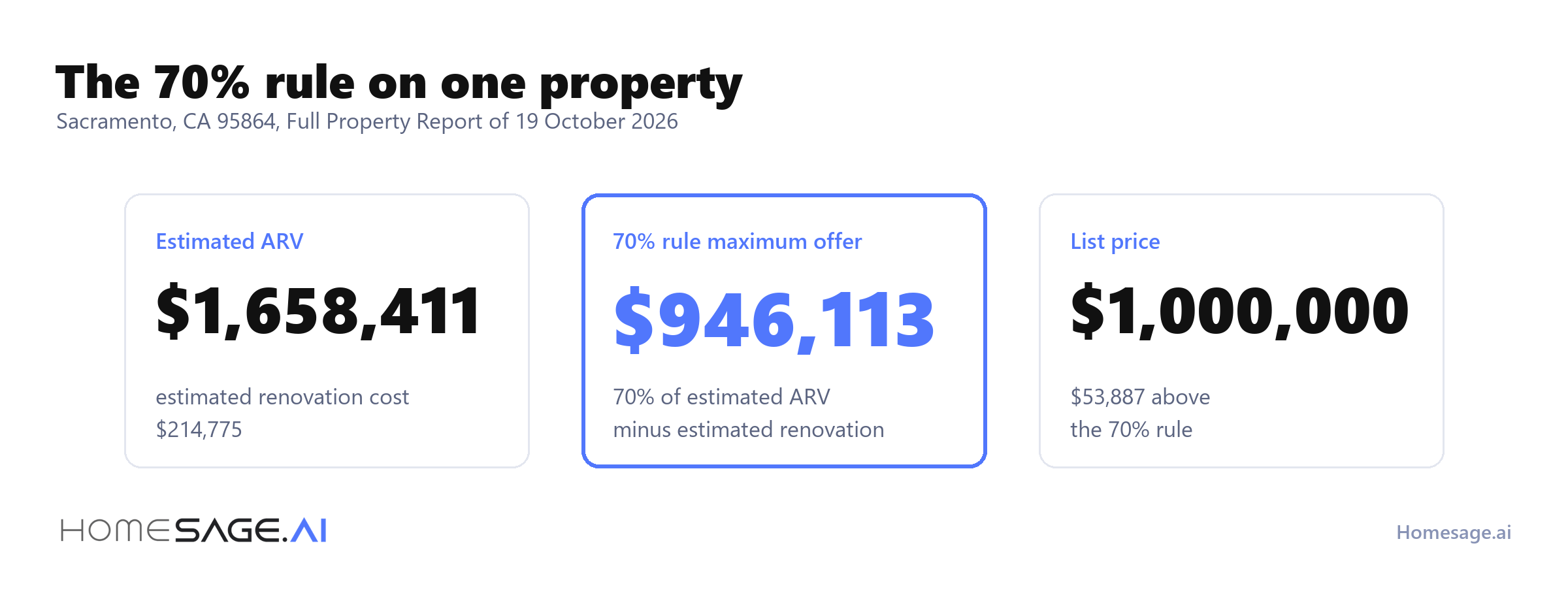
A $658,411 spread still misses the 70% rule by $53,887.
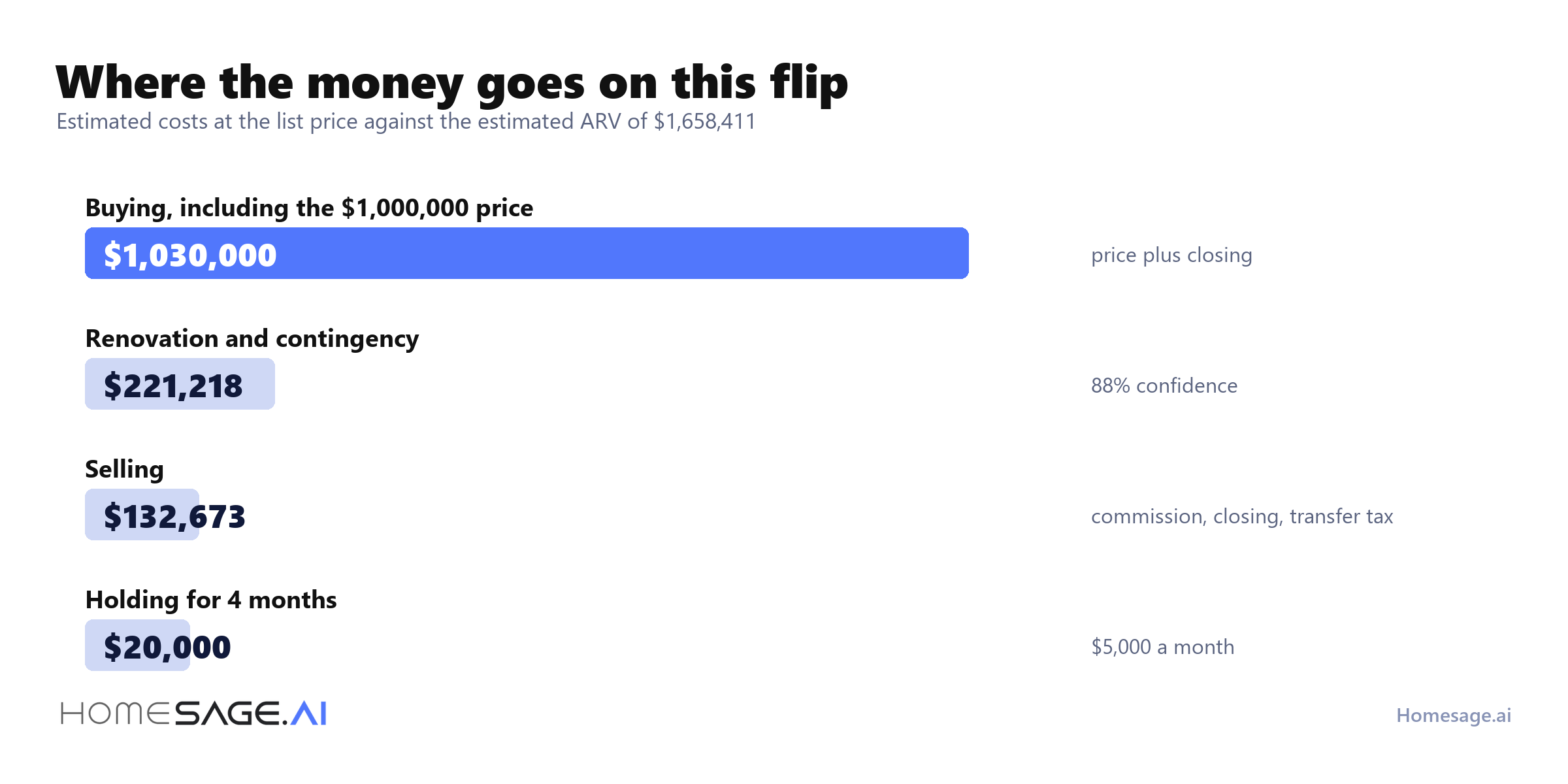
The rule is stricter than the report's own flip estimate. Buying at the list price and selling at the estimated ARV leaves an estimated $254,520 after every cost. The report puts the return at 18.2%, on an estimated total cost of $1,403,891. Selling costs an estimated $132,673, and 4 months of holding adds $20,000.
How to work out the 70% rule on a flip
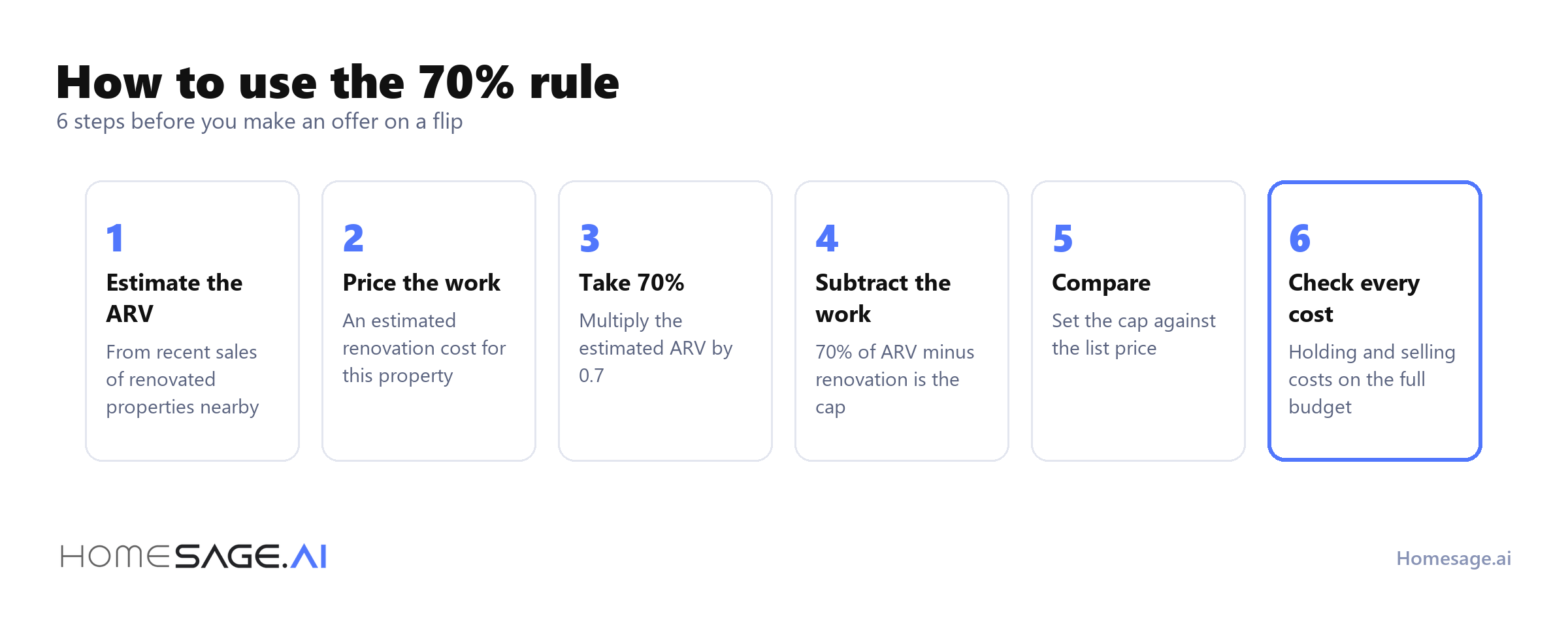
- Estimate the ARV from recent sales of renovated properties nearby. See what after-repair value means.
- Price the work for this property's condition, with a contingency.
- Multiply the estimated ARV by 0.7. Here that is $1,160,888.
- Subtract the estimated renovation cost. Here that leaves $946,113.
- Compare the result with the list price. Here the list price is $53,887 higher.
- Check the full budget before you offer. Holding and selling costs sit inside the 30%, and on this property they come to $152,673.
What moves the 70% rule maximum up or down
The estimated ARV moves it most. Each $100,000 change in the estimated ARV moves the maximum offer by $70,000. Each $10,000 of renovation moves it by $10,000 the other way.
Market speed changes what the 30% has to cover. The report's market outlook for this ZIP code shows homes averaging 45 days on market. Each month of holding this property costs an estimated $5,000.
Common 70% rule mistakes to avoid
- Reading the spread as profit: This property shows a $658,411 spread, and the report's flip estimate leaves $254,520 at the list price.
- Forgetting selling costs: Commission, closing, and transfer taxes come to an estimated $132,673 here.
- Applying 70% to every price level: FlipperForce notes the rule gets less reliable for high-value properties. Check the full budget on a property like this one.
- Using the list price as the ARV: The estimated ARV comes from sales of renovated properties, not from what the seller asks.
Frequently asked questions
What is the 70% rule formula?
What does the other 30% cover?
Does the 70% rule work on expensive properties?
Is the 70% rule the same as the maximum allowable offer in a report?
Is flipping still profitable with the 70% rule?
Ask Sage for the 70% rule on any address
Sage, our assistant, returns the estimated ARV and estimated renovation cost for any US address from inside the AI tool you already use.
- Homesage.ai Full Property Report for a single-family property in Sacramento, California (95864), generated 2026-10-19.
- FlipperForce, the 70% rule in house flipping, read 2026-10-14.
- ATTOM Q2 2026 U.S. Home Flipping Report, published 2026-10-01.