“Quick answerOften yes, because the yield is rarely where you live. On 6 October 2026, 3 of 894 active listings in San Jose cleared a 6% cap rate. In Cleveland, 63 of 1,000 did. The catch is condition. 17 of those 63 Cleveland listings were in outdated, poor or very poor condition, and you cannot walk any of them. Buy remotely only when you can read condition, debt and location risk before you fly.”
Most investors start where they live. It is the market they understand, and the one they can drive to on a Saturday.
That instinct is expensive. Rental yield follows price-to-rent ratios, and those vary more between metros than between houses inside one metro.
Returns exist in markets you have never visited. The hard part is seeing a property well enough to buy it from 2,000 miles away.
What the numbers actually say
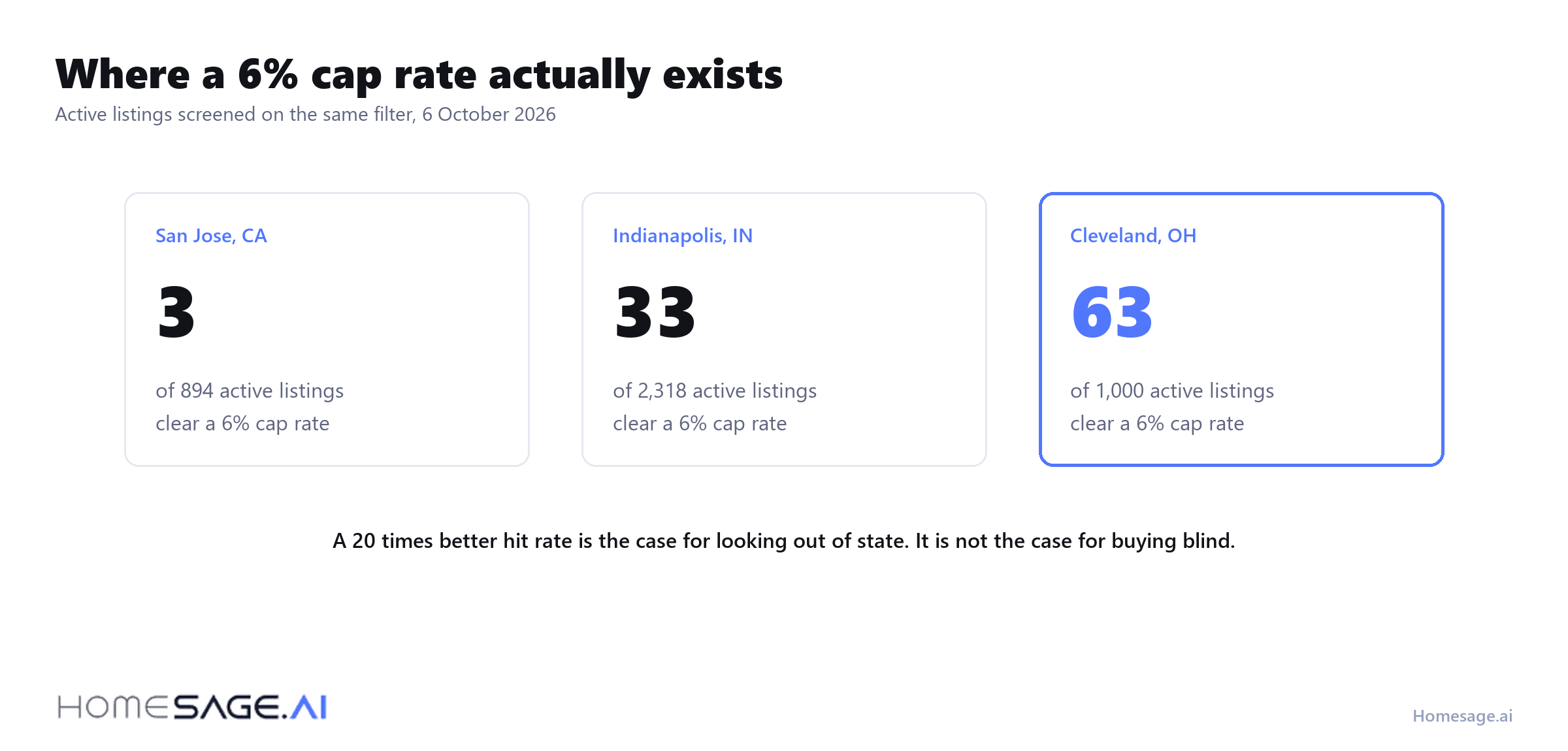
We ran the same screen across 3 cities on 6 October 2026. Active listings, no other filter, then the subset clearing a 6% capitalisation rate.
A cap rate is annual net operating income divided by price. 6% is a common floor for a buy-and-hold rental.
| Market | Active listings | Clear a 6% cap rate | Hit rate |
|---|---|---|---|
| San Jose, CA | 894 | 3 | 0.3% |
| Indianapolis, IN | 2,318 | 33 | 1.4% |
| Cleveland, OH | 1,000 | 63 | 6.3% |
Homesage.ai property database, active listings, 6 October 2026. Counts move daily.
An investor in San Jose has 3 qualifying properties in the entire city. An investor willing to look at Cleveland has 63. That is a 20 times difference in how often the screen finds anything.
Why the cheap market is not automatically the right one
High yield and bad condition travel together. A house prices low because something is wrong with it, and from another state you cannot tell which.
Of the 63 Cleveland listings clearing a 6% cap rate, 17 were in outdated, poor or very poor condition. Another 10 were in excellent or good condition.
That second number is the one that matters. It is the set you could act on without a flight.
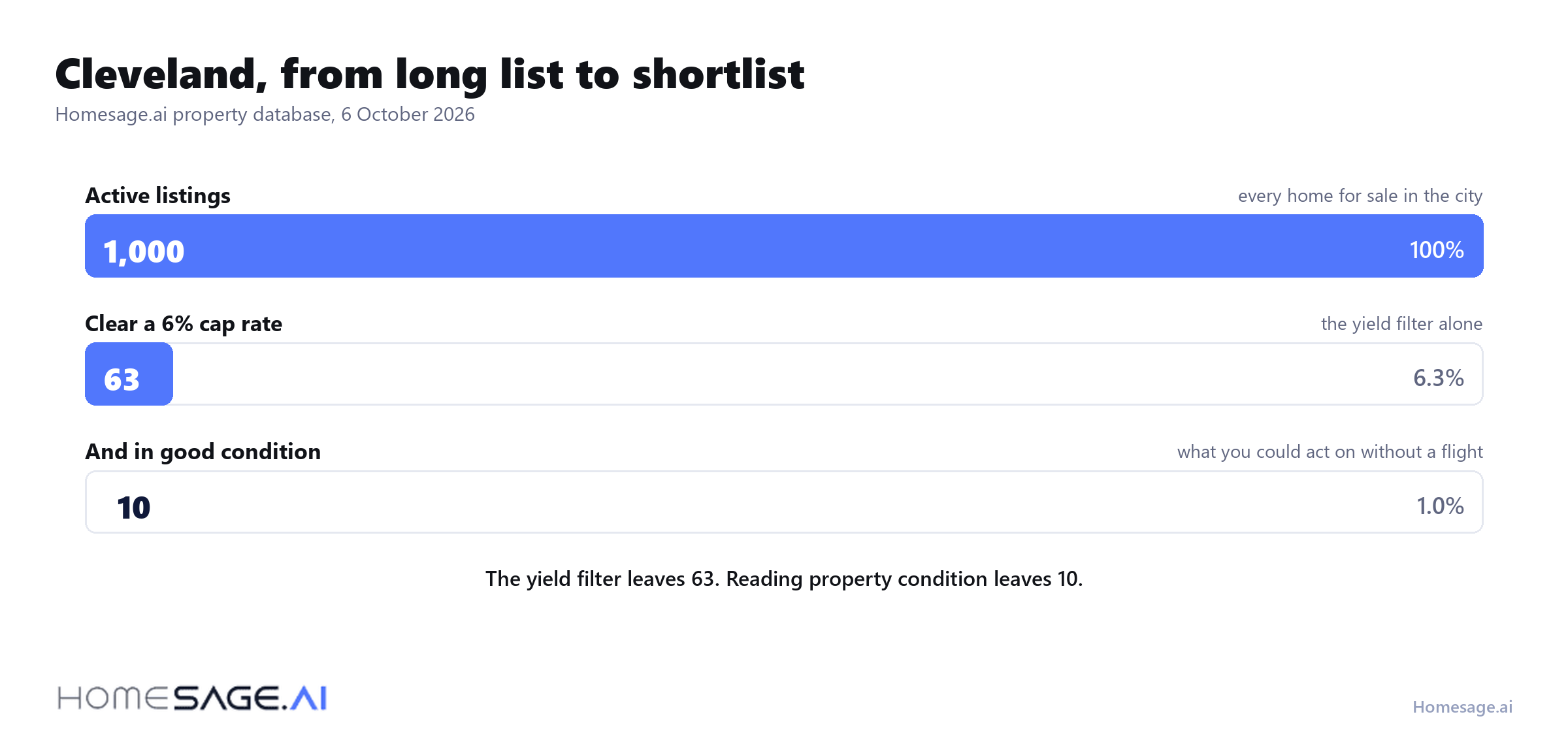
Homesage.ai property database, Cleveland active listings, 6 October 2026.
A screen that stops at yield hands you 63 candidates, a quarter of which need work you have not priced. A screen that reads property condition hands you 10.
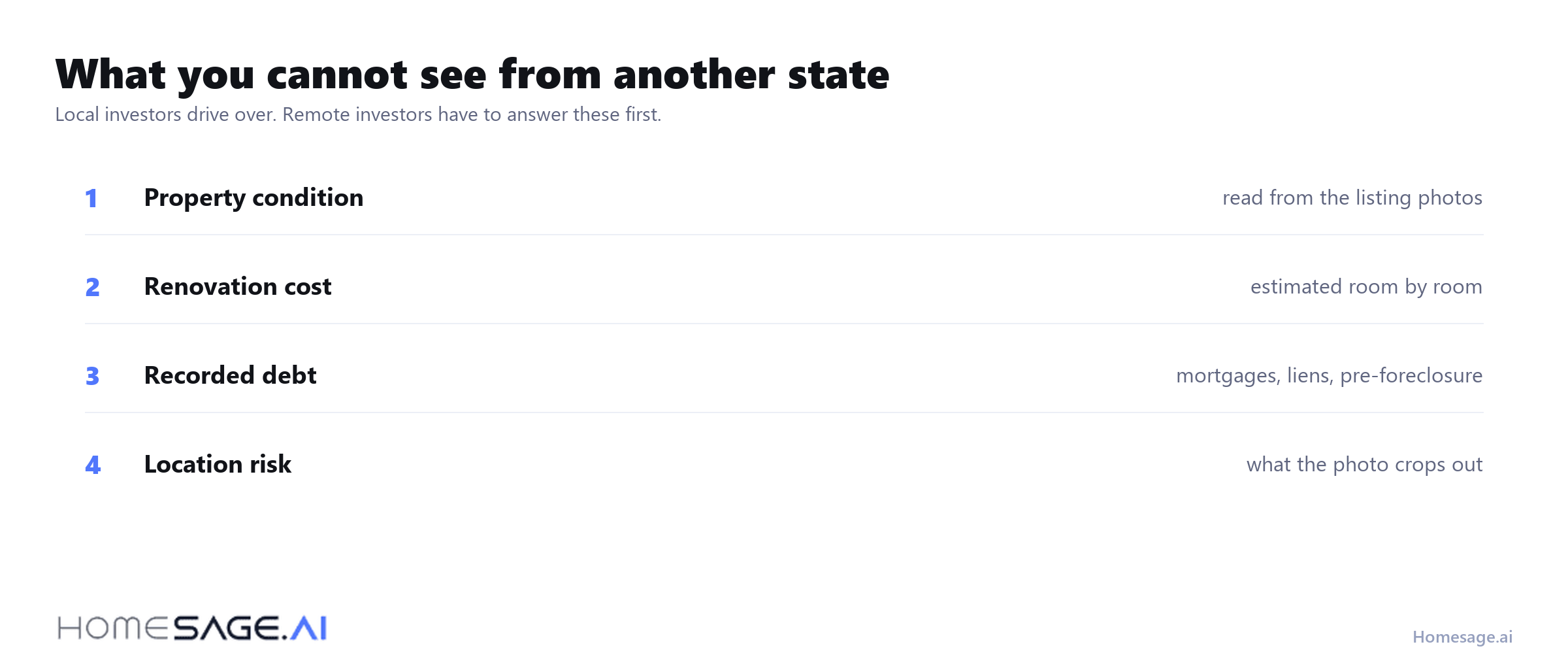
The 4 things you cannot see from another state
Local investors solve these by driving over. Remote investors have to solve them with data before they book anything.
- Property condition. The property photos are chosen to sell. A property condition score reads those photos and grades every house on one scale. Listings then compare against each other, not against the agent who wrote the copy.
- What the work costs. An estimated renovation cost, broken down room by room, turns “needs updating” into a number you can subtract from the yield.
- What is recorded against it. Active mortgages, involuntary liens and pre-foreclosure status change who you are negotiating with and how fast they need to move.
- What surrounds it. Location risk flags catch the things a photo crops out.
How to run the screen
The order matters. Each step should cut the list before the next one costs you anything.
- Pick 2 or 3 metros on price-to-rent, not on familiarity.
- Filter on your yield floor. Cap rate or cash-on-cash, whichever your financing makes real.
- Filter on property condition before you look at any photo. This is where 63 became 10.
- Price the work on whatever survives, then re-check the yield against purchase plus renovation.
- Pull liens and pre-foreclosure status on the shortlist. Then book the trip.
Homesage.ai previews the match count and the credit cost before a search charges. Steps 1 to 3 cost nothing while you are still narrowing.
Here is that screen run on Cleveland, with a 10% cap rate floor and a price band set. Six properties survive the whole market, and every one carries its property condition, rent and cap rate.
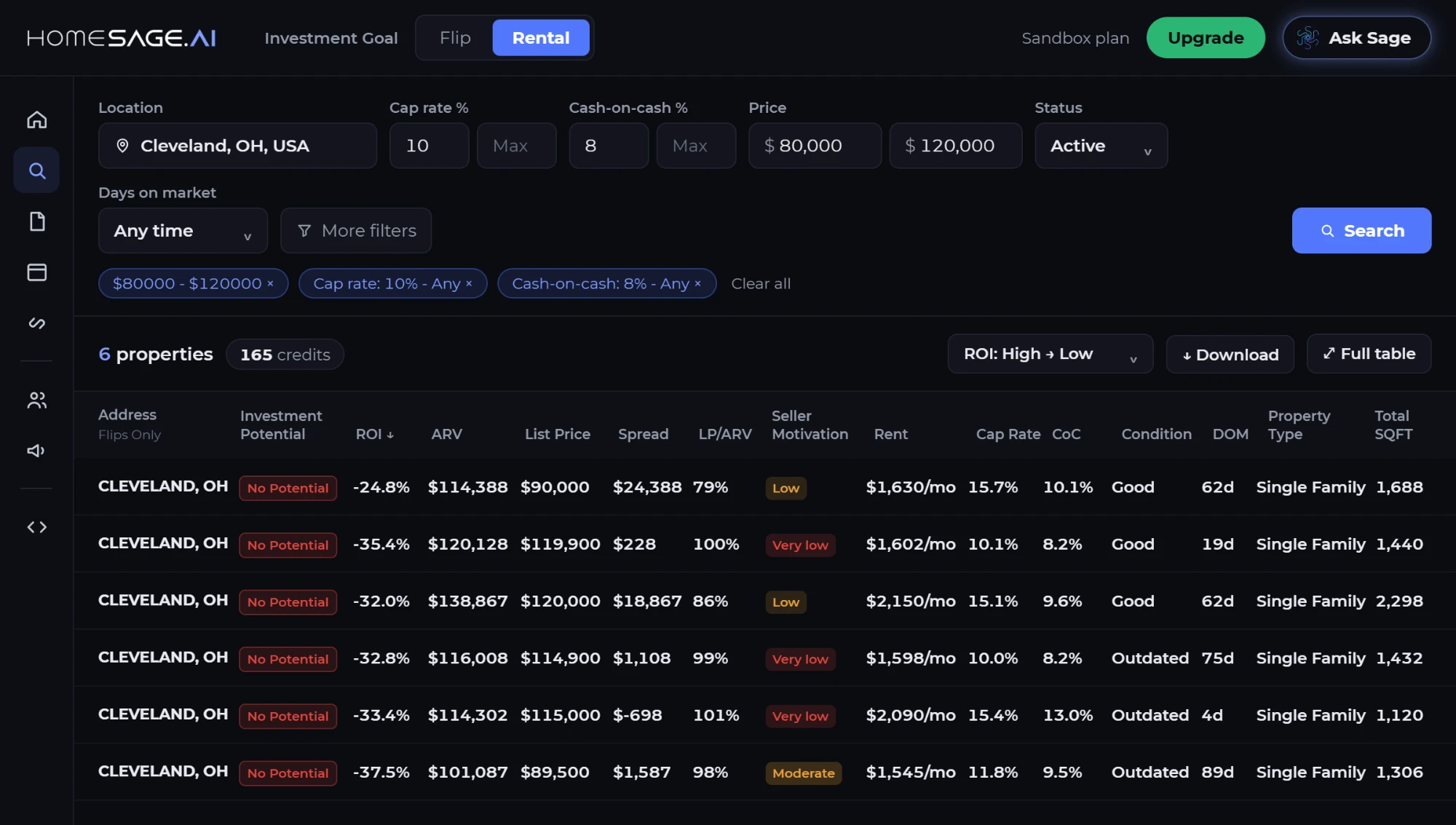
Days on market is the cheapest negotiating signal in the screen. Across the 6 Cleveland rentals we pulled on 6 October 2026, it ran from 4 days to 75. A house 75 days in is a different conversation from one listed on Friday.
Here is a short video on what a single property report returns.
What remote ownership costs
A yield that works on screen still has to survive the overhead of owning a house you cannot visit.
- Management. Someone collects the rent, answers the call at 11pm and turns the unit. Price it as a share of collected rent and subtract it before you compare markets. At 10% of a $1,630 monthly rent that is $1,956 a year.
- Vacancy. An empty month costs a month of rent, and you are not there to show the unit.
- The first trip. Budget one visit before closing even when the data is good. Flights and 2 nights cost less than a wrong purchase.
- Work you cannot supervise. A contractor quoting from photos prices risk into the number. Treat the estimated renovation cost as a floor.
Run those 4 through your own model before you set a 15% cap rate in one city against a 5% cap rate in another. Check what your model already subtracts, because a cap rate quoted before management is not the return you keep.
The people you need on the ground
Data narrows the list. It does not turn a key or meet a contractor.
- A property manager. The one hire that makes remote ownership work. Interview 3 and ask each how many units they run per member of staff.
- A contractor who quotes from photos. Then confirms on site. The estimated renovation cost gives you a number to check the quote against.
- An inspector. Booked before the contract, not after. A property condition score reads photos and is not an inspection.
- An agent who will walk it for you. On video, through the rooms the listing photos avoided.
Assemble that list before you make an offer. Building it after a contract is signed is how a 60-day close becomes a 90-day one.
Ask Sage before you book a flight
You do not have to learn another interface to run this. Sage is our AI assistant, and it runs the same screen from a plain-language question inside the AI tool you already use.
Connect Homesage.ai to Claude, ChatGPT, Gemini or Perplexity through our Real Estate MCP and ask about the market you are considering.
“How many active listings in this city clear a 6% cap rate, and how many of those are in good condition?”
Setting this up in ChatGPT takes 3 steps. Connect to ChatGPT in the MCP portal, then ask in plain language.
Key takeaways
- Yield is rarely where you live. On 6 October 2026, 3 of 894 San Jose listings cleared a 6% cap rate against 63 of 1,000 in Cleveland.
- 20 times better hit rate is the case for buying out of state. It is not the case for buying blind.
- 17 of those 63 Cleveland listings were in outdated, poor or very poor condition. 10 were in excellent or good condition.
- Property condition is the filter that turns a remote long list into a shortlist you can act on.
- Run yield, then property condition, then renovation cost, then liens. Book the flight last.
Conclusion
Buying a rental in a market you do not live in is worth it when the data replaces the drive. The yield is rare where you live. On 6 October 2026, 3 of 894 San Jose listings cleared a 6% cap rate against 63 of 1,000 in Cleveland.
The test is simple. Buy remotely once you can read property condition, recorded debt and location risk before you book a flight. Cheap on its own is not a reason. In Cleveland, that reading took 63 candidates down to the 10 you could act on.
Price the overhead before you compare 2 yields. Management, an empty month and work you cannot supervise all come out of the number on screen.
Then buy the people as carefully as the house. A manager, a contractor and an inspector are what turn a screen into an asset you never have to visit.
Start with an API key, screen a metro you have never visited, and compare what comes back with the market you know.
Frequently asked questions
Is it worth buying a rental in a market I don’t live in?
What cap rate should an out-of-state rental clear?
How do I check a property’s condition from another state?
What goes wrong with out-of-state rentals?
Do I need a property manager in a remote market?
Estimated values. Not investment advice. Data as of 2026-10-06. Counts come from the Homesage.ai property database and change daily. Cap rate is calculated at all-cash, 20% down, 4.5%, 30-year assumptions, and only properties with a verified rent carry the metric. Evaluate every property against your own finances, local costs and a professional inspection.