
Data fragmentation, inconsistent quality, and high access cost remain the top stumbling blocks for real estate data infrastructure across all major markets, according to Warwick Business School’s 2025 PropTech research.
If that maps to your production environment, you’re not dealing with a vendor problem; you’re dealing with an architecture problem. And in 2026, that distinction costs engineering teams months.

This post breaks down exactly where real estate data stacks break under scale, and the layered architecture fix that enterprise PropTech teams are implementing now.
What “Scaling Problem” Actually Means in This Context
The phrase gets overused. In real estate data specifically, a scaling problem isn’t simply “more traffic.” It’s a compounding failure across three dimensions simultaneously:
- Volume: query loads that exceed what a single API provider or ingestion pipeline was designed to handle
- Heterogeneity: data arriving in different schemas, refresh frequencies, and access protocols from dozens of upstream sources
- Dependency depth: AI/ML features that rely on clean, current, enriched property data failing silently when upstream data drifts
Most stacks handle one or two of these in isolation. Few handle all three at once, which is when production incidents become expensive.
Why Real Estate Data Is Uniquely Hard to Scale
Real estate data doesn’t behave like standard application data. It’s geographically fragmented, structurally inconsistent, and governed by a patchwork of regional contracts.
According to RESO, as of mid-2025 there are over 500 individual MLS systems in the United States alone. Each operates on slightly different schema standards, update frequencies, and access protocols. A developer building a national property search platform isn’t integrating one data source, they’re managing a federation of hundreds, each with its own failure modes.
Add public records (assessor, deed, tax liens), AVM layers, permit history, condition scoring, and rental comps to that federation, and normalization alone becomes a full-time engineering job.
This is the real estate data stack’s structural problem: it’s not just volume, it’s heterogeneity at every layer. For a broader look at how these data sources fit together, the developer’s guide to real estate data is a useful reference before diving into architecture decisions.
The 4 Signs Your Stack Is About to Break Under Load
Before rebuilding anything, diagnose the actual failure point. These four signals appear consistently across PropTech teams operating at enterprise scale:
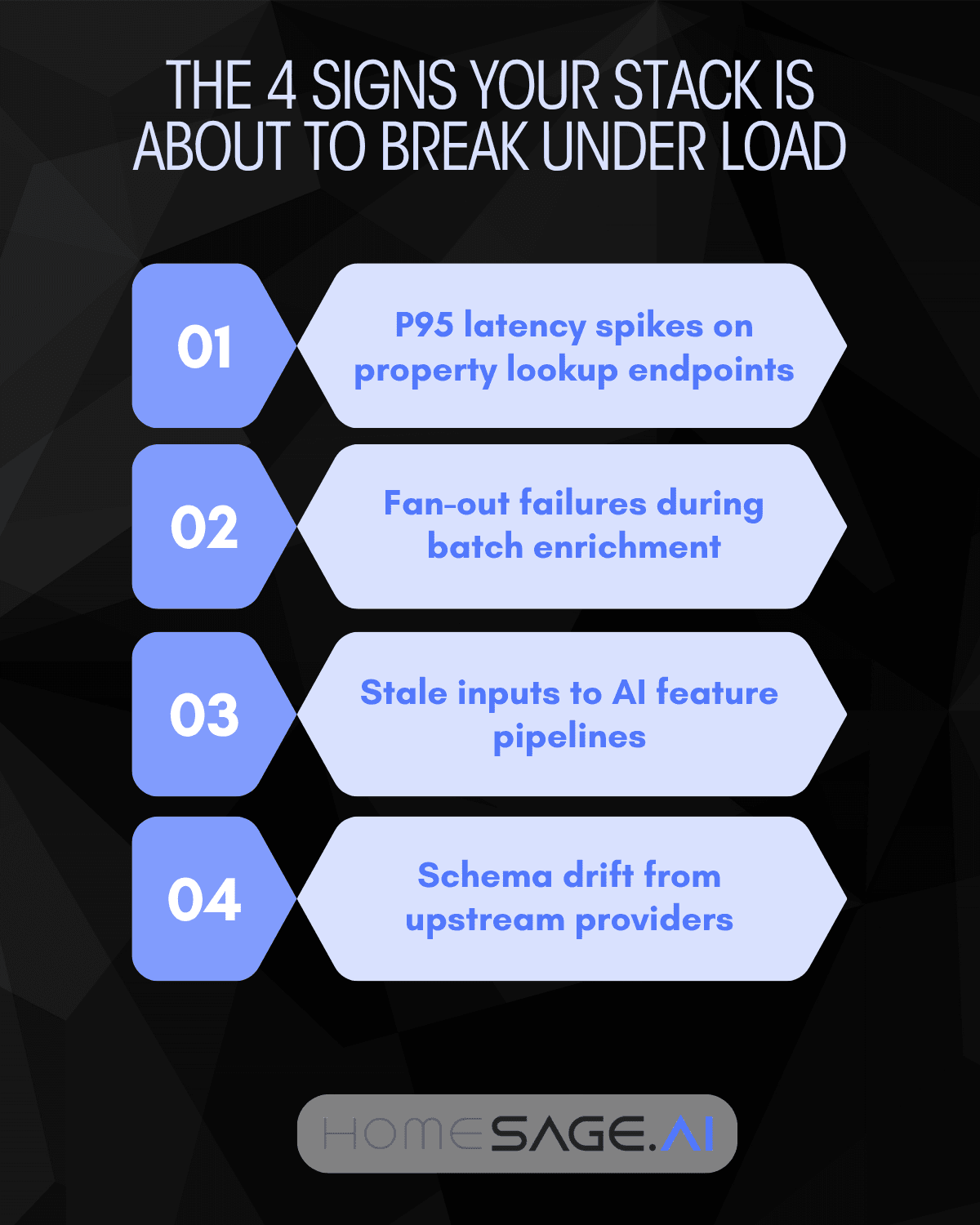
1. P95 latency spikes on property lookup endpoints
If your 95th percentile response time on a /property/{id} call exceeds 800ms, every downstream feature: AVM calls, investment scoring, comps aggregation, is stacking that latency. Users feel it; most don’t report it before churning.
2. Fan-out failures during batch enrichment
Enriching 100,000 addresses in parallel triggers rate limits or partial failures that silently corrupt your enriched dataset. No retry logic catches every edge case when the problem is upstream throughput design, not transient errors.
3. Stale inputs to AI feature pipelines
Your valuation model was trained on data refreshed weekly. Your production ingestion pipeline refreshes monthly. The model’s accuracy drifts without visibility until a high-value client flags a bad estimate and opens a support ticket.
4. Schema drift from upstream providers
One MLS provider renames a field. Your ETL job silently drops it for 36 hours before an alert fires. By then, thousands of property records will have missing values baked into downstream systems and model training sets.
If two or more of these describe your current production state, the issue isn’t the data providers. It’s the absence of a deliberate architecture. Understanding why real estate platforms are switching data providers often starts with diagnosing these exact symptoms.
The Enterprise Fix: A Layered Architecture for 2026
The fix is not switching vendors. It’s redesigning the stack with explicit layers, each with a single responsibility and a clean failure boundary.
Layer | Responsibility | Failure Mode Without It |
Ingestion | Pull from MLS feeds, public records, third-party APIs | Monolithic pull jobs that fail silently or block downstream |
Normalization | Standardize schema across all upstream sources | Schema drift corrupts downstream enrichment and AI inputs |
Storage | Queryable, scalable data warehouse with partitioning | Full table scans at query time; latency grows with data volume |
Enrichment API | Add AVM, ARV, comps, condition scores, and investment scoring | AI features built on raw, unvalidated property data |
Application Layer | Serve enriched data to product surfaces and ML models | Over-fetching, N+1 query patterns, and missing caching strategy |
Each layer must fail independently and recover without poisoning the upstream state. This is what “enterprise-grade” means operationally: not a pricing tier, but clean separation of concerns with explicit contracts between layers.
The enrichment API layer delivers the fastest ROI with the least rework. Instead of building AVM logic, comps engines, and investment scoring from scratch, teams integrate a purpose-built real estate data API that returns these outputs as structured JSON, already normalized, already validated, and tested against a large national property dataset. Pick one with our property data API comparison. Start from the 7 best property data APIs.
For the criteria that separate enterprise-ready providers from the rest, must-have features in a real estate API are worth reviewing before finalizing your vendor shortlist.
For teams weighing whether to adopt MCP-based integrations alongside REST APIs in this architecture, the MCP vs APIs comparison for real estate covers the tradeoffs in detail.
What Enterprise-Grade Looks Like at the Enrichment Layer
When evaluating an enrichment API for this architecture, six criteria separate production-ready providers from those that work fine in demo environments:
- National coverage with a consistent schema. Does it cover all 50 states with normalized field names, or does quality degrade outside major metros?
- Data freshness cadence. How frequently is the underlying property data refreshed? Weekly minimum for AVM reliability; daily for investment scoring accuracy.
- Documented rate limits per endpoint. Are throughput limits published per endpoint, or discovered through 429 errors in production?
- Uptime SLA with credit provisions. Is there a documented SLA with remedies, or a vague “best effort” in the terms?
- Enrichment depth beyond raw facts. Does the API return just square footage and bedrooms, or enriched outputs: ARV, renovation cost estimates, rental projections, and investment potential scoring?
- Developer documentation quality. Can a new engineer be onboarded in under a day? Documentation quality signals how seriously the vendor treats the developer experience at scale.

Homesage.ai’s Real Estate APIs are built for this layer: 155M+ US properties, structured JSON outputs covering AVM, ARV, comps, renovation cost estimates, and investment scoring, with documentation built for teams integrating at volume.
For IT developers evaluating options, the API pricing plans use a credit-based model that scales with actual usage rather than locking teams into fixed seat tiers.
For provider comparisons across the enrichment layer, the top real estate APIs of 2026 and the best real estate APIs for building apps are worth reviewing. For implementation, real estate API integration best practices and integrating real estate APIs with AI cover the engineering decisions that follow.
The Cost of Waiting
The global Enterprise Data Management market is projected to reach $134.1 billion in 2026, growing at 11.2% annually, according to market research from Market.us. PropTech teams that defer the architectural fix aren’t just accumulating technical debt; they’re falling behind competitors who are already serving enriched property data in under 300ms.
The engineering cost of a properly layered data stack is consistently lower than maintaining fragmented pipelines, and it unlocks the AI features users will treat as baseline expectations by 2027.
Key Takeaways
- Real estate data doesn’t scale like standard SaaS data; 500+ MLS systems create structural heterogeneity that can’t be patched at the query layer.
- The four failure signals (P95 latency spikes, batch fan-out failures, stale AI inputs, schema drift) appear in production before planning surfaces them.
- The enterprise fix is a deliberately layered architecture: separate ingestion, normalization, storage, enrichment, and application concerns with clean failure boundaries between each.
- The enrichment API layer delivers the fastest ROI, integrating a pre-built real estate data API that eliminates months of AVM, comps, and scoring development.
- Documentation quality, data freshness cadence, and uptime SLAs are the three non-negotiable criteria when vetting enterprise enrichment API providers.
Conclusion
Your real estate data stack isn’t broken because your team made poor decisions; it’s broken because the problem is genuinely hard, and the tooling has matured faster than most stack designs. The 2026 fix isn’t a rip-and-replace: it’s a deliberate layering of responsibilities, with a reliable enrichment API at the core handling the property intelligence your product depends on.
Ready to see what a purpose-built enrichment API looks like at the data layer? Explore Homesage.ai’s Real Estate & Home Improvement APIs or book a developer demo to review response schemas and throughput documentation before committing.
If you want to move from an architecture diagram to working integration, the video below walks through the Homesage.ai Real Estate API from a developer’s perspective: authentication, endpoint structure, response schemas, and how to pull enriched property data for a given address in your first call.
People Also Ask
Q: What is a real estate data stack?
A: A real estate data stack is the layered set of data infrastructure components: ingestion pipelines, normalization engines, data warehouses, enrichment APIs, and application serving layers that a PropTech platform uses to collect, standardize, enrich, and deliver property data to its product and AI features.
Q: What causes scaling problems in real estate data pipelines?
A: The primary causes are structural heterogeneity (500+ MLS systems with inconsistent schemas), data freshness mismatches between ingestion and model training cycles, and the absence of clean failure boundaries between pipeline layers, so a single upstream change breaks multiple downstream systems.
Q: How often should real estate data be refreshed for AI models?
A: At a minimum, a weekly refresh cadence is required for AVM reliability. Investment scoring models benefit from daily updates on key signals like days-on-market, price reductions, and comparable sales activity. Stale inputs are the most common cause of valuation model accuracy degradation in production.
Q: What should I look for in an enterprise real estate data API?
A: Evaluate providers on: national coverage with consistent schema, documented rate limits per endpoint, uptime SLA with credit provisions, data freshness cadence, enrichment depth (AVM, ARV, comps, investment scoring), and documentation quality sufficient for fast onboarding.
Q: What’s the fastest way to fix a fragmented real estate data stack?
A: Rather than rebuilding every layer simultaneously, teams gain the most leverage by first inserting a clean enrichment API between their raw data layer and their AI/application layer. This decouples enrichment logic from ingestion complexity and immediately improves data quality for downstream features.




Lin June 2, 2026
This is a really good article!
Emma June 2, 2026
Good read!