
There are more than 580 individual Multiple Listing Services (MLSs) in the United States, according to the Real Estate Standards Organization via Realtyna, each with its own database, field naming conventions, and vendor access rules.
For developers building PropTech apps or investment platforms, that fragmentation is the defining challenge of MLS data integration. Choosing the wrong method costs months of rework.
This guide covers the 3 architectural approaches developers use in 2026 to solve it, with a clear comparison of trade-offs for each.
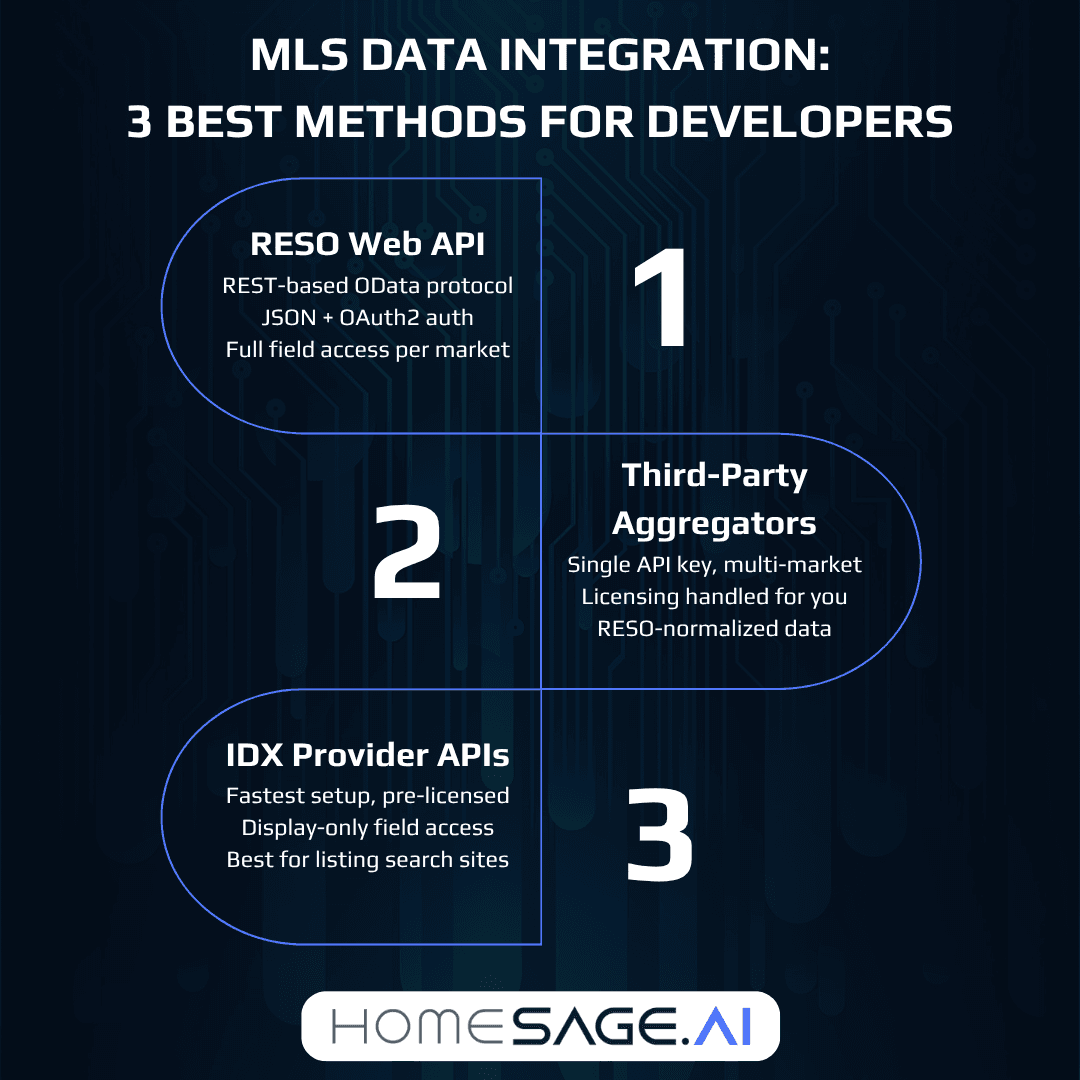
Why MLS Data Integration Is Harder Than It Looks
MLS data is the gold standard for on-market listing accuracy. Active status, price history, media, open house schedules; no public data source matches it. But accessing it is not like calling a single API endpoint.
Each of the 580+ US MLSs sets its own licensing terms, credentialing process for technology vendors, and field naming conventions. Until recently, most MLSs used RETS, a proprietary, XML-based protocol requiring bulk polling and local data replication. RETS is now deprecated and being retired across markets.
The RESO Web API replaced it as the industry standard, and any new MLS integration started in 2026 should use it exclusively.
For the foundational context on real estate data sources beyond MLS, see the developer’s guide to real estate data sources and best practices.
Method 1: Direct RESO Web API Integration
The RESO Web API is a REST-based, OData-powered protocol defined by the Real Estate Standards Organization. It returns JSON, uses OAuth2 authentication over TLS, and exposes standardized resources: Property, Member, Office, Media, with field names governed by the RESO Data Dictionary 2.0.
How it works:
- Apply for vendor access directly with the target MLS
- Sign the data use agreement and receive OAuth2 credentials
- Query via OData syntax: filter, paginate, $select for field subsets
- Normalize incoming fields to Data Dictionary 2.0 standard
- Handle delta-polling or webhook events for real-time updates
Best for: platforms covering 1–3 specific markets in depth, applications requiring full field access, including private fields like ShowingContact, and teams with existing MLS licensing relationships.
Limitations: credentials must be obtained market-by-market, display and redistribution rules vary per MLS, and compliance monitoring is an ongoing engineering responsibility.
Method 2: Third-Party MLS Data Aggregators
Aggregators solve the multi-market scaling problem. Instead of negotiating with each MLS individually, developers connect to a single API endpoint that aggregates normalized data from dozens or hundreds of MLSs. The aggregator handles licensing, field normalization to the RESO Data Dictionary standard, media ingestion, and delta updates, typically at 1-minute polling intervals per market.
How it works:
- Sign a single vendor agreement with the aggregator
- Receive a unified REST API key
- Query standardized endpoints. One field schema across all markets
- Receive pre-normalized data without writing custom mapping per MLS

Best for: national or multi-regional PropTech platforms, applications where development speed matters more than full field depth, and teams without existing MLS relationships or in-house licensing staff.
Limitations: display rules from source MLSs are passed through and must still be enforced in your UI, field availability varies by market, and subscription costs scale with query volume.
For a broader view of real estate API options that complement MLS feeds, see the best real estate APIs for building apps in 2026.
Method 3: IDX Provider APIs
IDX (Internet Data Exchange) provider APIs offer the fastest path to displaying MLS listings, with pre-built compliance already included. IDX providers hold the MLS licensing themselves, and developers consume their API under the provider’s approved vendor status without signing direct MLS agreements.
How it works:
- Sign up with an IDX provider approved by the target MLS
- Access their REST or GraphQL endpoint with a single API key
- Query listings with pre-filtered, display-rule-compliant data
- Enforce attribution requirements: broker credit, listing timestamps, in your UI
Best for: real estate websites and portals focused on listing search, brokerages needing fast public-facing search features, and developers who want listing data without direct MLS vendor agreements.
Limitations: field sets are restricted to IDX-approved display fields only: ShowingContact, seller information, and private remarks are excluded. IDX data is not suitable for bulk analytics, AI model training, or investment-grade data pipelines.
For a full architectural breakdown of how IDX and direct API approaches compare, see IDX vs API for real estate websites in 2026.
Comparison: Which MLS Integration Method Is Right for You?
| Factor | RESO Web API (Direct) | Aggregator | IDX Provider API |
|---|---|---|---|
| Market coverage | Single market per credential | Multi-market via one key | Varies by provider |
| Field depth | Full, including private fields | RESO-normalized subset | IDX display fields only |
| Licensing | Per-MLS agreements required | Aggregator handles | Provider holds license |
| Data freshness | Near real-time | ~1-min polling | Often 15+ min delayed |
| Setup complexity | High | Medium | Low |
| Best for | Deep single-market apps | National platforms | Listing search sites |
Layering AI Intelligence on Top of MLS Data
MLS feeds deliver listing data. They do not deliver investment analysis. A listing shows price and bedrooms; it doesn’t tell a developer or investor whether the deal pencils out.
Homesage.ai analyzes 155M+ US properties using AI-powered valuation models that incorporate over 50 data points per property, including computer vision-based condition assessments, After Repair Values, renovation cost estimates, and rental income projections.
None of these exist in any MLS feed. Developers integrating MLS data into investment platforms can query the Homesage.ai Real Estate API alongside any listing feed to produce complete deal analysis in a single workflow.
For implementation patterns that combine listing APIs with AI-powered property data, see integrating real estate APIs with AI for developer strategies. For a curated comparison of top real estate API options, see the top real estate APIs in 2026.
Key Takeaways
- RETS is deprecated. RESO Web API (REST, JSON, OData) is the 2026 standard for direct MLS integration. New RETS pipelines should not be started.
- Aggregators reduce multi-market complexity. They handle licensing, normalization, and RESO compliance, ideal for platforms covering 10+ markets with a single API key.
- IDX provider APIs are the fastest start. Pre-licensed, display-ready data pipelines suited for listing search. Not for analytics or AI pipelines.
- Data Dictionary 2.0 is the normalization baseline. It defines standard field names (ListPrice, StandardStatus, LivingArea) so data from different MLSs maps to one schema.
- MLS data covers listings, not investment intelligence. AI-powered property analytics: AVMs, ARV, and renovation cost estimates must be layered on top via supplemental APIs for investment-grade use cases.
Understanding which MLS integration method fits your stack is step one; the next is knowing what you can build on top of it. The video below walks through how IT developers are using the Homesage.ai Real Estate APIs to enrich MLS listing data with AI-powered property intelligence and drive real business results.
See the full options for property data integration for your app.
Conclusion
MLS data integration in 2026 comes down to three decisions: how many markets you need to cover, how deep your data requirements go, and how much licensing complexity your team can absorb. Direct RESO Web API access gives the most field depth per market. Aggregators give multi-market scale without per-MLS paperwork. IDX provider APIs offer the fastest launch for display-only listing search.
Whatever method you choose, MLS data alone covers listings, not investment intelligence. Layering AI-powered property analytics on top is what turns a listing search into a decision-support tool that developers and their clients can rely on.
Explore what Homesage.ai’s real estate APIs for IT developers can add to your MLS integration stack: full property reports, AI valuations, and 50+ data points per address, all accessible via a single REST endpoint. Check out the real estate API integration best practices guide to plan your architecture before you build.
People Also Ask
Q: What is the best method for MLS data integration in 2026?
A: The RESO Web API is the current industry standard for direct MLS integration, replacing the deprecated RETS protocol. For multi-market platforms, third-party aggregators that normalize data to the RESO Data Dictionary 2.0 standard are the most practical choice. IDX provider APIs are best for listing display-only use cases where full field access is not required.
Q: Is RETS still usable for MLS data integration?
A: RETS (Real Estate Transaction Standard) has been deprecated and is being retired across US MLSs. New integrations should not use RETS. The RESO Web API is the certified replacement standard, now in production at most active MLSs in 2025–2026.
Q: What is RESO Data Dictionary 2.0?
A: RESO Data Dictionary 2.0 is the standard field-naming schema for MLS data. It defines consistent field names and data types such as ListPrice, StandardStatus, and LivingArea, so that data from different MLSs can be mapped to a single unified schema without custom normalization per market.
Q: Can developers access MLS data without a real estate license?
A: Yes, through approved vendor agreements. Developers can access MLS data as licensed technology vendors by signing a data use agreement with the target MLS directly, or through an approved aggregator or IDX provider. Direct MLS access typically requires a technology provider application and compliance review by the MLS.
Q: What data does an MLS feed not include?
A: MLS feeds cover listing data: price, status, photos, open houses, and basic property attributes. They do not include investment analytics such as AI-powered property valuations (AVMs), After Repair Value estimates, renovation cost projections, or rental income models. These require supplemental property intelligence APIs layered on top of the listing feed.





Jane May 12, 2026
Good article!
Peter May 12, 2026
Very helpful for developers
Emma May 13, 2026
Insightful!
Robin May 13, 2026
Very helpful!