
Reviewing 30 to 50 properties every week with spreadsheets and browser tabs is not a strategy. It is a bottleneck. By the time your manual real estate data analysis is done, the best deals are already gone. According to a recent Stessa-ResiClub investor survey, 65% of real estate investors say finding deals that cash flow is the most frustrating part of the buying process.
Explore the full playbook on AI real estate investing.The investors and realtors winning right now have one thing in common: they built automated pipelines that surface, score, and organize deals before they ever sit down for their weekly review. Less time on data. More time on decisions.
This article walks you through how to do that, from automating your property intake to tracking the metrics that actually matter. Platforms like Homesage.ai have made this kind of AI-powered property intelligence accessible to individual investors and brokerage teams, and we will show you exactly where it fits.

Why Manual Analysis Breaks Down at Scale
Manual research has real limits. It relies on whatever data you can find yourself, typically MLS listings and basic public records, and it produces inconsistent results depending on how much time you have that week. NAR’s 2025 Technology Survey found that 66% of real estate professionals adopt new technology primarily to save time, and deal analysis is one of the biggest time sinks in the business.
The bigger problem is opportunity cost. Every hour spent pulling comps or rebuilding ROI spreadsheets is an hour not spent negotiating or building your next deal. If you want to learn faster methods for analyzing investment deals, automation is the logical next step.
The fix is not working faster. It is redesigning your process so that data comes to you, already organized and scored.
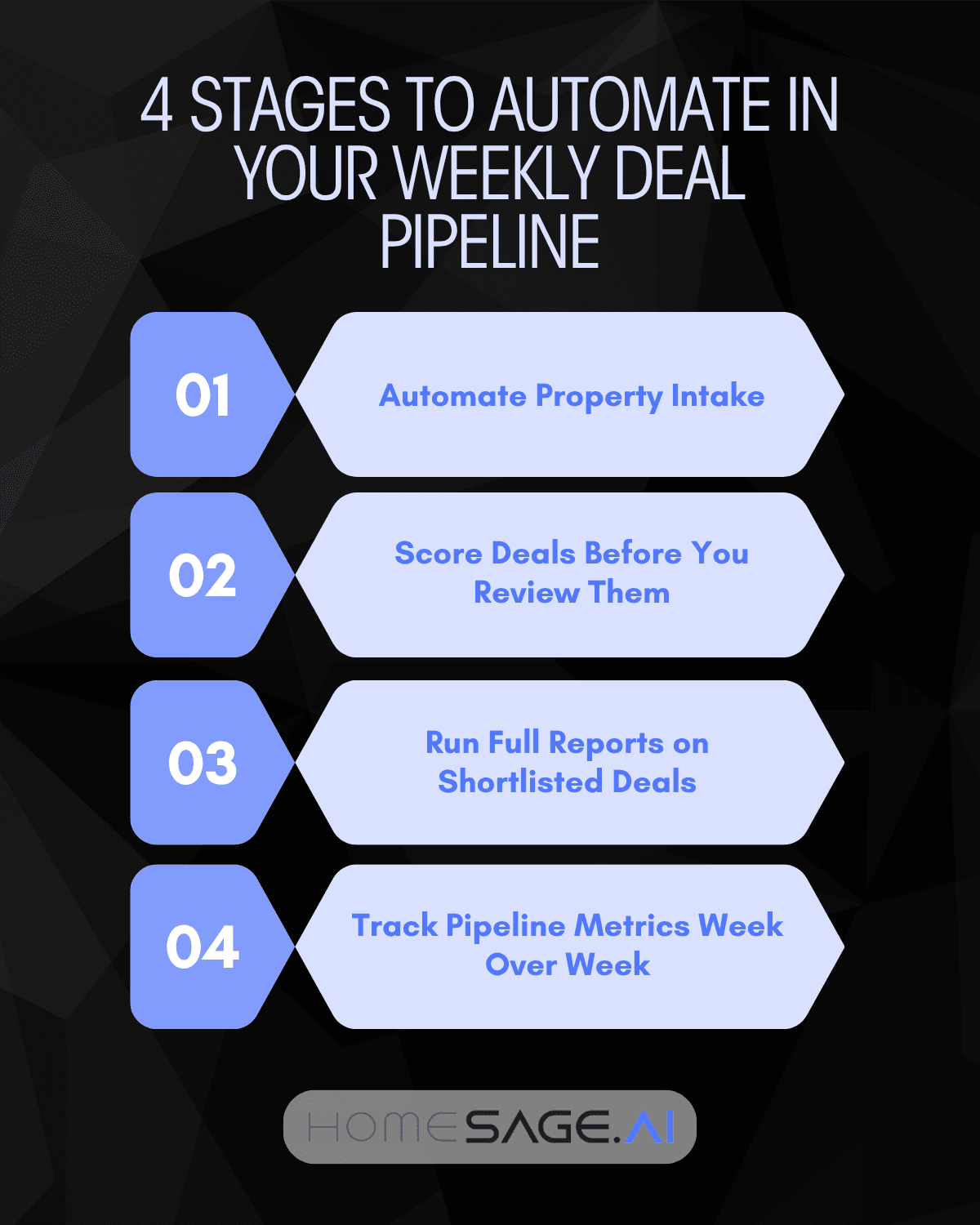
4 Stages to Automate in Your Weekly Deal Pipeline
1. Automate Property Intake
Stop starting each week with a blank search. Set your filters once for location, property type, price range, and deal type, and let the system pull matching properties automatically on a daily cadence.
Homesage.ai‘s AI-powered Investment Property Search does exactly this, scanning MLS and off-market listings and filtering by investment potential and property condition before results reach your queue. For realtors managing multiple investor clients, this alone eliminates hours of repetitive work every week. Whether you are searching for AI-powered investment properties or building a client-facing pipeline, automated intake is the foundation.
2. Score Deals Before You Review Them
Not every property that clears your filters deserves equal attention. An automated scoring layer ranks deals so you know where to start. These are the AI-powered metrics that matter most for weekly prioritization:
- Investment Potential Score: Is this property a strong investment or a pass?
- Price Flexibility Score (PFS): How much negotiating room does the listing have?
- Property Condition: Move-in ready, outdated, or a renovation project?
- Renovation Cost Estimate: What would it actually cost to bring this up?
- ARV Estimate: What is the realistic after-repair value vs. list price?
When these are pre-calculated for every property, your weekly review becomes a triage process, not a research project. You can generate Full Property Reports for any shortlisted deal to get these metrics in one view.
3. Run Full Reports on Shortlisted Deals
Once you have scored and prioritized your pipeline, only the top deals need deep analysis. That is where full property reports save the most time, pulling condition, renovation cost, rental projections, and investment score into a single view. Learning how to run comps with AI makes this step even faster.
4. Track Pipeline Metrics Week Over Week
Weekly metrics turn your pipeline into a feedback loop. Over time, you can see which filters produce your best deals and where to tighten your criteria. Track these every week:
- New deal volume by market and filter
- Average Investment Potential Score across your shortlist
- Price Flexibility trends in your target area
- Renovation cost distribution across shortlisted deals
- Rental yield projections for buy-and-hold candidates
Manual vs. AI-Automated Deal Pipeline
Pipeline Stage | Manual Approach | AI-Automated Approach |
Property Intake | Daily MLS searches, multiple tabs | Automated feed with pre-set filters |
Deal Scoring | Gut check or basic spreadsheet | AI-generated Investment Potential + PFS scores |
ROI Calculation | Manual formulas are error-prone | Instant ARV and rental projections |
Renovation Budgeting | Contractor calls or rough guesses | API-driven cost estimates per property |
Rental Projections | Market guesswork | Long-term and short-term rental API data |
Weekly Review Time | 10–25+ hours | 2–4 hours of human review |
The APIs That Power Automated Analysis
For investors and realtors building custom workflows, real estate data APIs are the most scalable path to automation. Rather than relying on a single dashboard, API-based architecture lets you plug property intelligence directly into your CRM, deal management tool, or custom platform.

Homesage.ai’s core APIs for weekly pipeline automation:
- Property Condition API: Classifies properties as Excellent, Good, Outdated, Poor, or Very Poor using AI image analysis
- Investment Potential API: Scores investment suitability based on location, market signals, and financial data
- Price Flexibility Score API: Estimates listing price negotiability
- Renovation Cost API: Provides rehab cost estimates without a contractor visit
- Long-Term Rental API: Delivers cash flow estimates, cap rates, and rental income projections
- Full Property Report API: Aggregates all of the above into one comprehensive property intelligence report
For developers building investor platforms, the APIs use standard REST architecture with clear API documentation. NAR’s 2025 Technology Survey also found that 82% of clients respond positively when agents integrate more technology in the buying and selling process, making automated reporting a client-facing advantage as well.
Key Takeaways
- Automate intake first. Set filters once and let a daily automated feed replace your manual search routine.
- Score before you review. AI-generated metrics like Investment Potential, PFS, and Property Condition tell you where to focus before you open a single listing.
- Use a consistent weekly format. Same metrics, same structure, every review cycle makes deal comparison faster and more reliable.
- Let APIs do the heavy lifting. Homesage.ai’s property intelligence APIs covering condition, renovation costs, rental projections, and investment scoring replace hours of manual data gathering with instant, property-level insights.
- Measure your pipeline, not just your deals. Weekly tracking of deal volume, average scores, and conversion rates helps you optimize your criteria over time.
Conclusion
The real estate professionals closing the most deals in 2026 are not working longer weeks; they have built smarter systems. Automating your real estate data analysis is not a shortcut. It is a process investment that compounds every week.
Start with one stage: automate your intake, add scoring, then build from there. When you are ready to move faster, Homesage.ai‘s suite of real estate investment tools gives you everything you need from property condition and renovation costs to rental ROI in one connected platform.
Want to see how these APIs work in a real integration? This walkthrough covers Homesage.ai‘s complete real estate data API suite, from setup to your first automated property report.
Frequently Asked Questions
Q: Do I need to be technical to automate my deal pipeline?
A: No. Many platforms offer dashboard-based automation with no code required. You define the metrics you need, such as condition, investment score, and renovation cost, and the platform delivers them automatically for each property.
Q: How often should I update my pipeline filters?
A: Review them monthly. If your pipeline is surfacing too many low-quality deals or too few strong ones, your criteria need adjustment. Tracking weekly metrics like average investment score and conversion rate gives you the data to make those calls.
Q: Can real estate data APIs connect to my existing CRM?
A: Most modern real estate APIs use standard REST architecture and can connect to popular CRM and deal management tools via direct integration or middleware like Zapier or Make.





Mike March 22, 2026
Very informative!
Ed March 26, 2026
Good read