
Quick answer: “A mortgage API moves loan data between systems, so a borrower does not type the same thing 4 times. 6 mortgage APIs are worth a developer’s time in 2026. Better embeds an application. Lender Logix and Proven ROI serve Encompass shops. Lender Connect serves UK brokers. The mortgage CRMs handle lead flow. Homesage.ai covers the collateral behind the loan. Most of them move the paperwork. Only some tell you what the property is worth.”
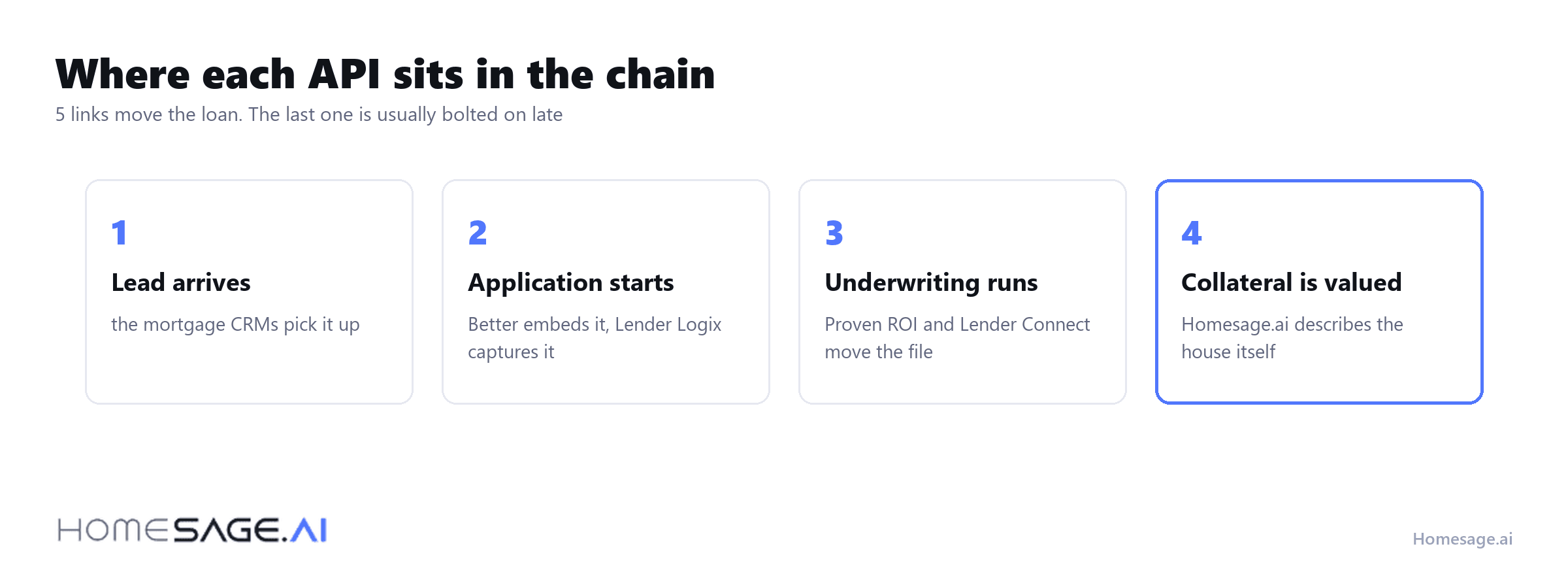
Mortgage software is a chain of systems that were never designed to talk to each other. A lead arrives in a CRM, an application starts in a portal, underwriting happens in a loan origination system, and the collateral sits in none of them.
A mortgage API is the joint between 2 links in that chain. Which joint you need depends entirely on where your chain is broken.
Most mortgage APIs move paperwork faster. Almost none of them tell you what the house securing the loan is actually worth.
What a mortgage API does
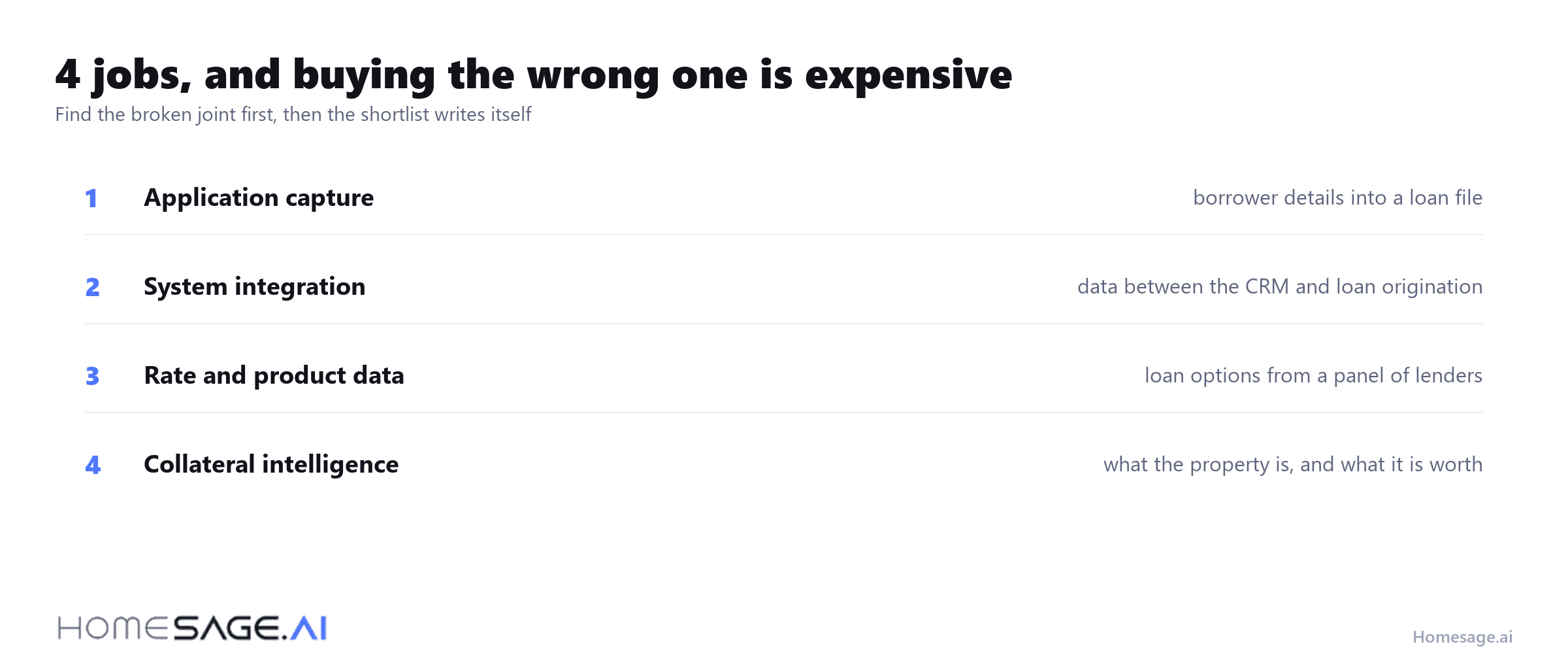
Strip the marketing away and these APIs do 4 distinct jobs. Buying one that does the wrong job is the common and expensive mistake.
| The job | What it moves | Who needs it |
|---|---|---|
| Application capture | Borrower details into a loan file | Anyone with a drop-off problem |
| System integration | Data between CRM and loan origination | Teams rekeying the same fields |
| Rate and product data | Loan options from lenders | Brokers comparing across a panel |
| Collateral intelligence | What the property is and what it is worth | Anyone lending against property condition |
What A Mortgage App API Needs to Handle
If you are building a consumer-facing product rather than wiring up a back office, the requirements change. A mortgage app API has to survive being called from a phone by somebody who is not a loan officer.
- Partial state. People abandon applications and come back 3 days later, so the API has to hold an incomplete file.
- Progressive disclosure. Ask for income before asking for tax returns, or the drop-off happens at screen 2.
- Honest errors. A validation failure has to say which field and why, in language you can show a borrower.
- A property call. Almost every mortgage app eventually needs to show what the house is worth, and that is a different API from the loan one.
That last point is where most mortgage app builds stall. The loan side is well served, and the collateral side is usually an afterthought bolted on late.
1. Better, for an embedded mortgage application
Better is a digital mortgage lender that exposes its application flow to partners, so a product can offer a mortgage without becoming a mortgage company.
The appeal is that the regulated work stays with the lender. You integrate an experience rather than building origination, compliance and servicing yourself.
Best for fintech and proptech products that want a mortgage inside their own journey. See Better.
2. Lender Logix, for Encompass shops
Lender Logix builds point-of-sale tools around Encompass rather than replacing it. Its application capture is the part lenders talk about, because it shortens the first step for the borrower.
Best for lenders already committed to Encompass who want a better front door. See Lender Logix.
3. Proven ROI, for the CRM to origination gap
Proven ROI bridges HubSpot and Encompass, which sounds narrow because it is. For the shops that run exactly that pair, it removes the rekeying between marketing and the loan file.
Best for marketing-led lenders on that specific stack. See Proven ROI.
4. Lender Connect, for UK brokers
Lender Connect from Iress gives UK brokers API access to a panel of lenders from 1 place, instead of a portal per lender. It pre-fills a large share of a decision in principle.
Best for UK brokers managing several lender relationships. See Iress.
5. The mortgage CRMs, for lead flow
BNTouch, Jungo and Shape all expose APIs that connect lead sources to loan origination. Jungo sits on Salesforce, Shape leans on lead scoring, BNTouch focuses on lead capture.
These are CRM products with APIs rather than APIs in their own right. That distinction matters when you are estimating integration work.
Best for teams whose problem is lead handling rather than underwriting.
6. Homesage.ai, for the collateral behind the loan
Better, Lender Logix, Proven ROI, Lender Connect and the mortgage CRMs all move the loan. Our platform describes the property that loan is secured against, which is the part a spreadsheet cannot infer.
Property condition analysis reads the property photos and returns a property condition score, from Excellent and Good down to Outdated, Poor and Very Poor. One address also returns an estimated current value and an estimated after-repair value, an estimated renovation cost with a confidence score, and a Seller Motivation Score.
For renovation lending, the after-repair figure is the whole decision. It covers 155M+ US property records and ships as REST and JSON with an API key issued in minutes.
Best for lenders and investors where the state of the property changes the answer. See the real estate APIs.
How the 6 mortgage APIs compare
| API | The job it does | Knows the property | Best for |
|---|---|---|---|
| Better | Embedded application | No | Products offering a mortgage |
| Lender Logix | Application capture | No | Encompass lenders |
| Proven ROI | CRM to origination | No | HubSpot and Encompass shops |
| Lender Connect | Multi-lender access | No | UK brokers |
| Mortgage CRMs | Lead flow | No | Lead-heavy teams |
| Homesage.ai | Collateral intelligence | Yes, including property condition | Renovation estimates and investor lending |
Why the collateral read decides renovation lending
A loan against a house that needs work is a loan against a future value, not a current one. The gap between the 2 is where the deal lives or dies.
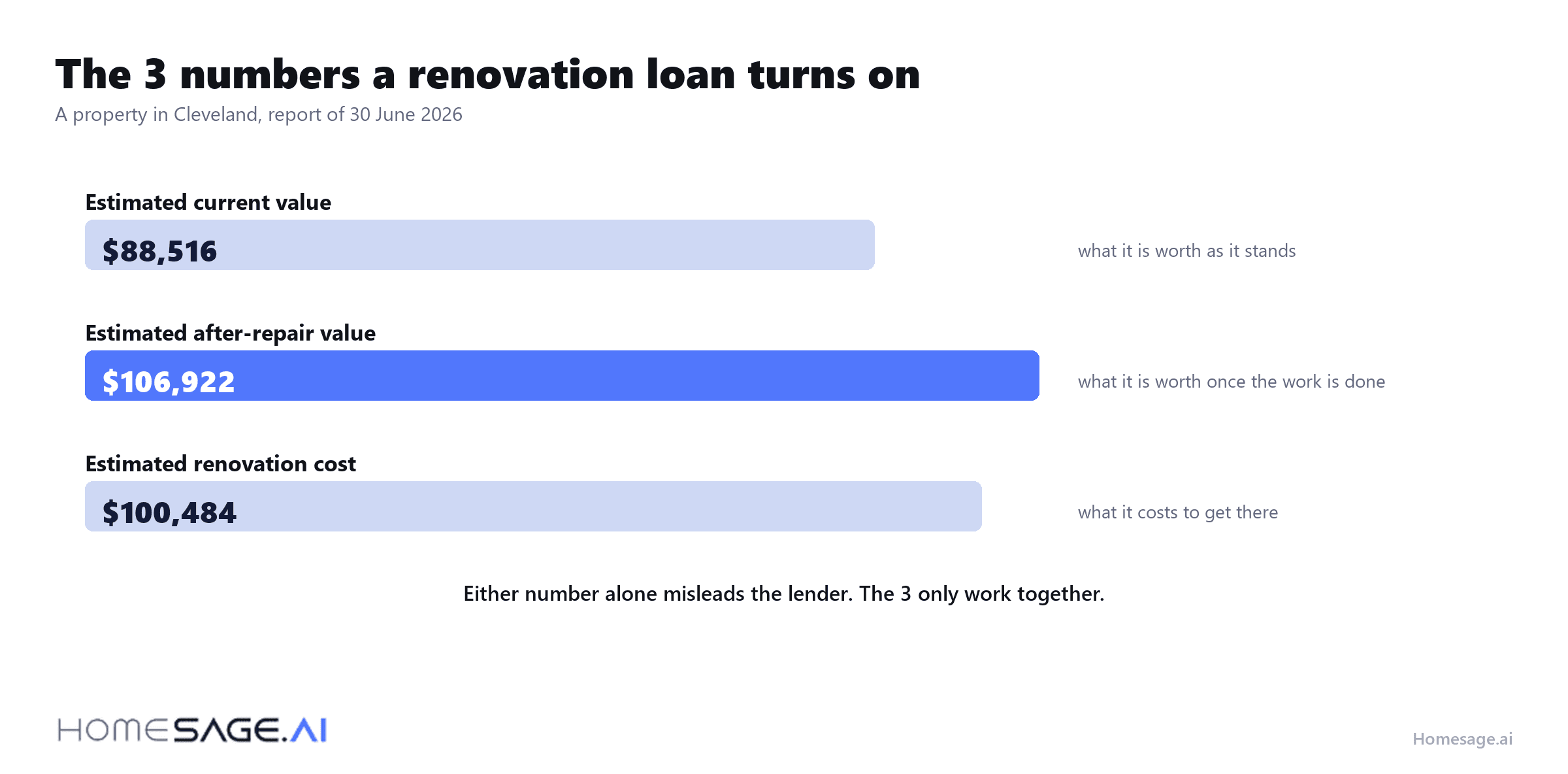
We ran 1 Cleveland property through the Full Property Report on 30 June 2026. The estimated current value came back at $88,516 and the estimated after-repair value at $106,922. The estimated renovation cost was $100,484.
Estimated values. Not investment advice. Data as of 2026-06-30.
A lender looking only at the current value sees a modest loan. A lender looking only at the after-repair value sees a better one. Both are wrong until the renovation cost sits beside them.
How to choose
- Find the broken joint first. Application, integration, rates or collateral. The category picks itself once you name it.
- Check what is regulated. An embedded application moves compliance to the lender, which is a feature, not a detail.
- Ask what the API knows about the property. 5 of the 6 here know nothing about it, which means a second integration.
- Test the time to first call. A sandbox you can reach today beats better documentation you cannot reach for 3 weeks.
- Read the security requirements early. Mortgage data carries obligations that are cheaper to design for than to retrofit.
- Look for a confidence signal on any valuation. A number with no uncertainty attached cannot be handled safely in a lending product.
Here is a short video on what a single property analysis returns.
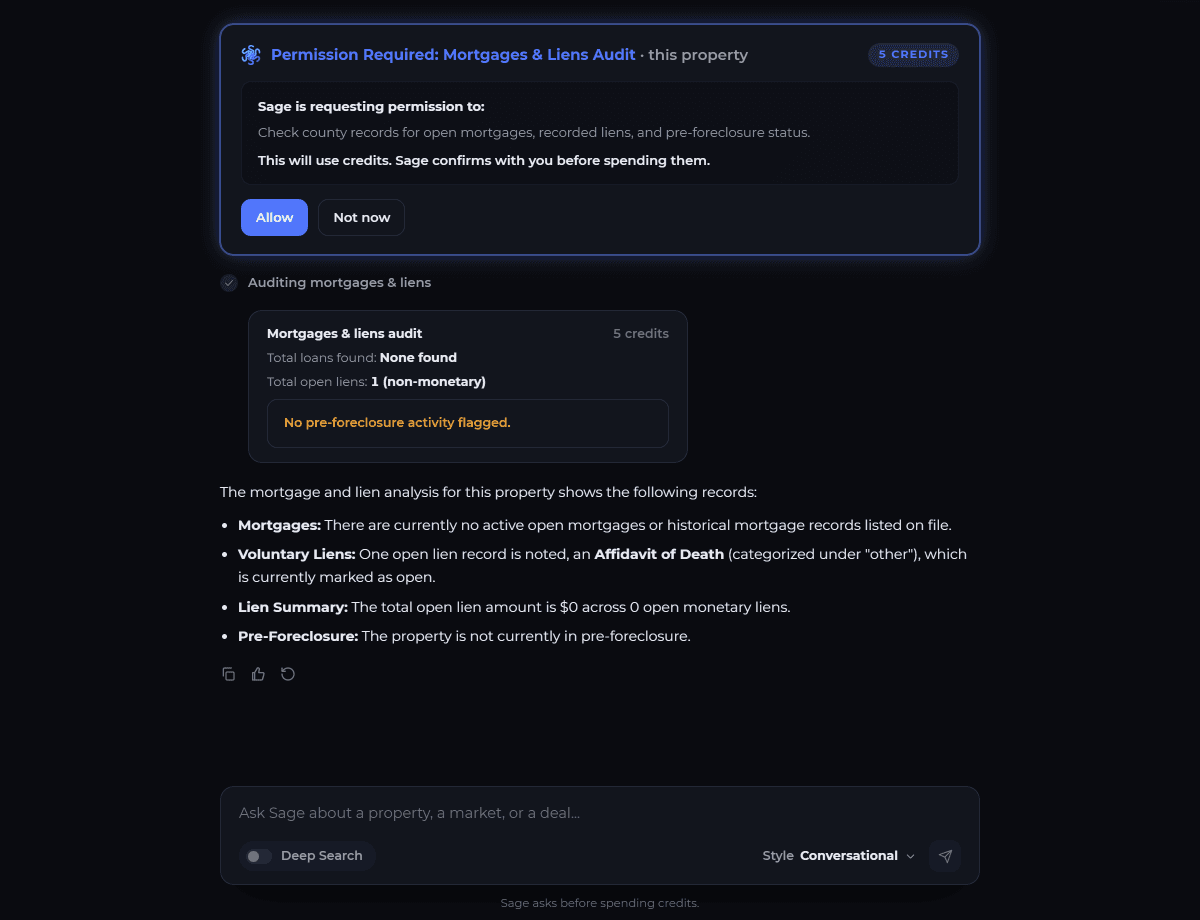
Ask Sage before you write the integration
Before committing a sprint, check the shape of the answer. Sage is our AI assistant, and it runs the same endpoints from a plain-language question inside the AI tool you already use.
Connect Homesage.ai to Claude, ChatGPT, Gemini or Copilot through our MCP connector and ask for the collateral view on an address.
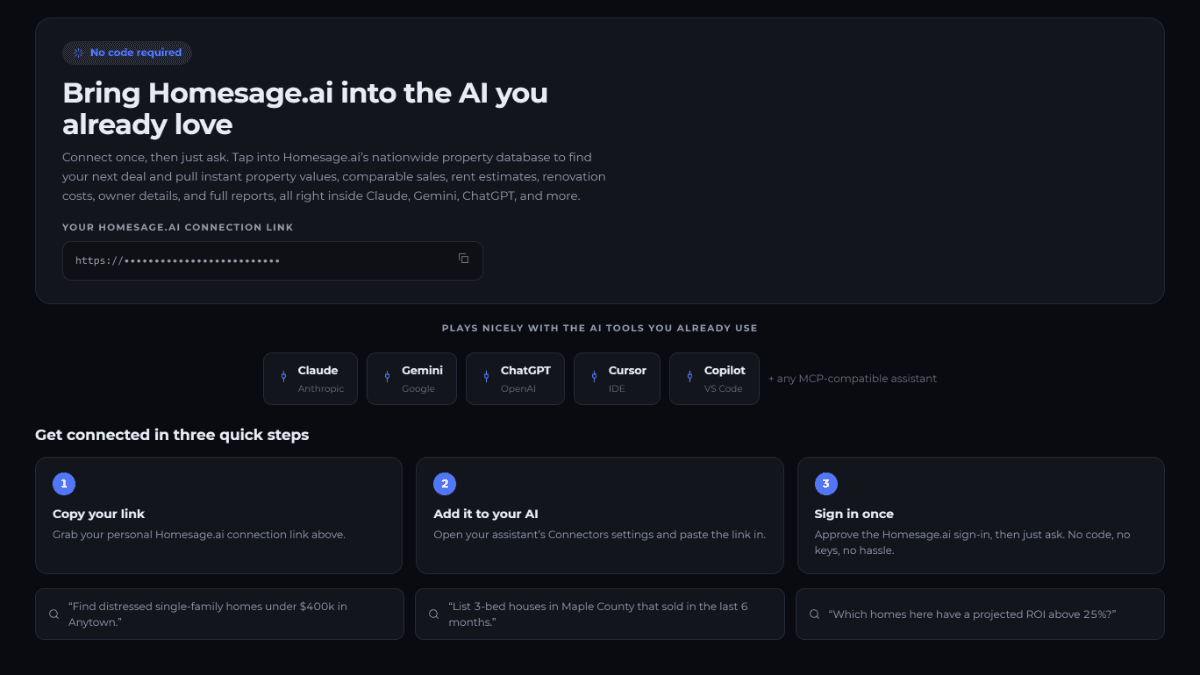
“What is the property condition of this house, what is it worth now, and what after the work?”
You see the real fields and the real numbers before building against them.
Key takeaways
- 6 mortgage APIs are worth a developer’s time in 2026. Better, Lender Logix, Proven ROI, Lender Connect, the mortgage CRMs and Homesage.ai.
- They do 4 different jobs. Application capture, system integration, rate access and collateral intelligence.
- A mortgage app API needs partial state, progressive disclosure and honest errors, because it is called by borrowers rather than loan officers.
- 5 of the 6 know nothing about the property. That gap is usually discovered late in a building.
- On 1 Cleveland property, an $88,516 current value sat against a $106,922 after-repair value and a $100,484 estimated renovation cost. The 3 numbers only mean something together.
Conclusion
The right mortgage API is the one that closes the joint that is actually broken in your chain. Name that first and the shortlist writes itself. If the missing piece is the property rather than the paperwork, start with an API key and run an address you already know.
Estimated values. Not investment advice. Data as of 2026-06-30. This article is general information. Figures come from a Homesage.ai Full Property Report for a property in Cleveland, pulled on 30 June 2026, and change as the market moves. Third-party product capabilities are the vendors’ own published descriptions and change without notice. Lending terms and regulatory requirements vary by lender and jurisdiction.





Robin December 6, 2025
Insightful
Hamza December 7, 2025
Nice guide.
Adriano Mostafa December 8, 2025
Thanks for the insightful blog
Nourhan December 10, 2025
Thanks for sharing!