
“Quick answer 7 real estate data providers are worth shortlisting in 2026. CoreLogic, Homesage.ai, ATTOM, PropertyShark, Zillow, CoStar and Redfin. They are not competing for the same job. CoreLogic and ATTOM sell breadth to lenders and platforms. Homesage.ai sells investment analysis on 155M+ US property records. PropertyShark sells depth in dense metros, Zillow sells consumer reach, CoStar sells commercial and Redfin gives its market data away. 3 of the 7 offer a free real estate API or a free data download, covered below.
Choosing between the best real estate data providers is easier than the lists suggest, because they are not really substitutes. Every property decision now runs on somebody else’s data. The providers differ less in how much they hold than in what they let you do with it, and most shortlists never say that plainly.
Coverage is the easy part. What separates these 7 is whether the data arrives as records or as an answer.
1. CoreLogic, now Cotality
CoreLogic has been building US property data since 1968 and rebranded as Cotality in 2024. It is the backbone under a large share of US mortgage and insurance workflows.
It sells full property profiles covering structure, ownership, tax and hazard risk. It also sells risk analytics, market reports and compliance tooling. Delivery is by API, cloud and batch, and pricing is enterprise and negotiated.
Best for lenders, insurers and government teams that need depth and a compliance posture. See Cotality.
2. Homesage.ai
We provide insights on 155M+ US property records, and the product is the analysis rather than the export. One address in the Full Property Report returns a property condition score read from the property photos.
It returns an estimated current value and an estimated after-repair value. It returns an estimated renovation cost with a confidence score, plus rental and flip returns.
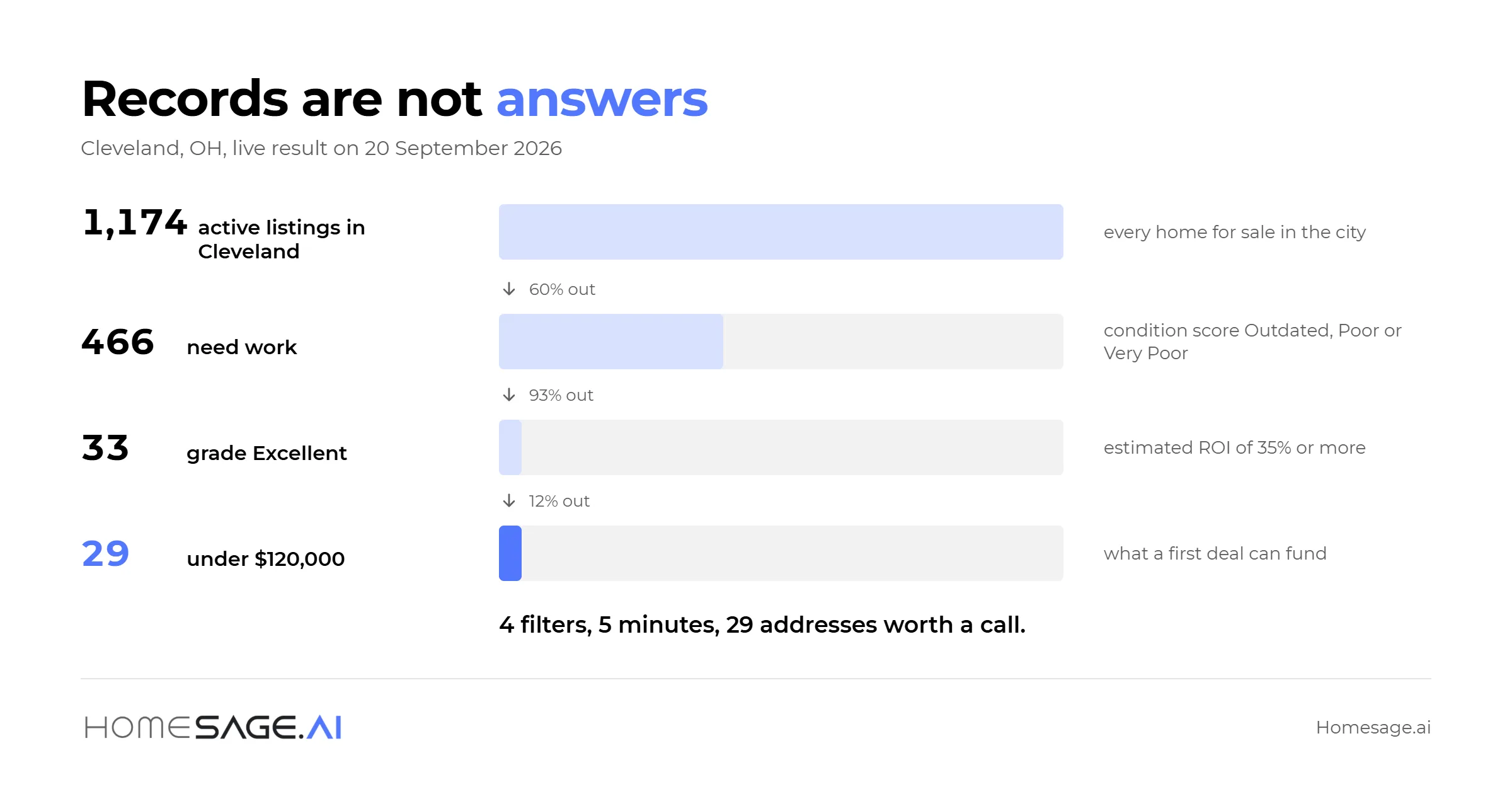
The difference shows up when you screen rather than look up. We ran Cleveland, OH through Investment Property Search on 20 September 2026 and took 1,174 active listings down to 29 candidates in 4 filters.
| Filter | What it keeps | Listings left |
|---|---|---|
| Cleveland, OH, active | Every home for sale in the city | 1,174 |
| Condition score Outdated, Poor or Very Poor | The houses with work to add value | 466 |
| Investment potential grade Excellent | Estimated ROI of 35% or more | 33 |
| List price up to $120,000 | What a first deal can fund | 29 |
Estimated values. Not investment advice. Data as of 2026-09-20.
There is a free Sandbox key if you want to try it before committing anything. Best for investors, agents and proptech teams who want a decision rather than a dataset. Developers can reach the same analyses through our real estate APIs.
3. ATTOM
ATTOM covers 158M+ US residential and commercial properties. Every record runs through a standardization process and carries a persistent ID that holds across datasets, which is what makes joins reliable at scale.
It ships by API, cloud and bulk export. Specialty overlays cover neighborhood, environmental, school and demographic data. Our comparison of when to use each real estate API covers where the 2 of us differ.
Best for platform builders, fintechs and public institutions. See ATTOM Data.
4. PropertyShark
PropertyShark trades national breadth for local depth. New York City is where that shows. It surfaces ownership records, title documents and permits. It also carries foreclosure and auction data, plus researched contact details behind LLC owners.
Best for commercial analysts and investors working a small number of dense metros. See PropertyShark.
5. Zillow
Zillow is the consumer front door and the widest-known valuation in the country. It publishes data on 124M homes and produces Zestimates on 116M of them, alongside the ZHVI market index and rental data.
Its research library downloads free. API access is a different matter. It is partner-gated, approval takes real time, and that is the constraint most teams hit. Our guide to the Zillow API for developers covers what you can and cannot get.
Best for consumer-facing products and market context. See Zillow Research.
6. CoStar
CoStar is the commercial standard. It tracks millions of buildings with leasing, sales and comparable data. It also owns the marketplaces it has acquired.
Best for commercial brokers, appraisers and portfolio managers. It is the wrong tool for a single-family investor. See CoStar.
7. Redfin
Redfin publishes a data center of downloadable market files. They cover prices and inventory, plus days on market and sale-to-list ratios, down to neighborhood level. There is no API and no approval, because there is no gate at all.
Its numbers come from a working brokerage. That is a strength for market truth and a limit for national uniformity, since coverage is deepest where Redfin transacts most.
Best for market research, charts and competitive analysis at no cost. See the Redfin Data Center.
Which of these offer a free real estate API
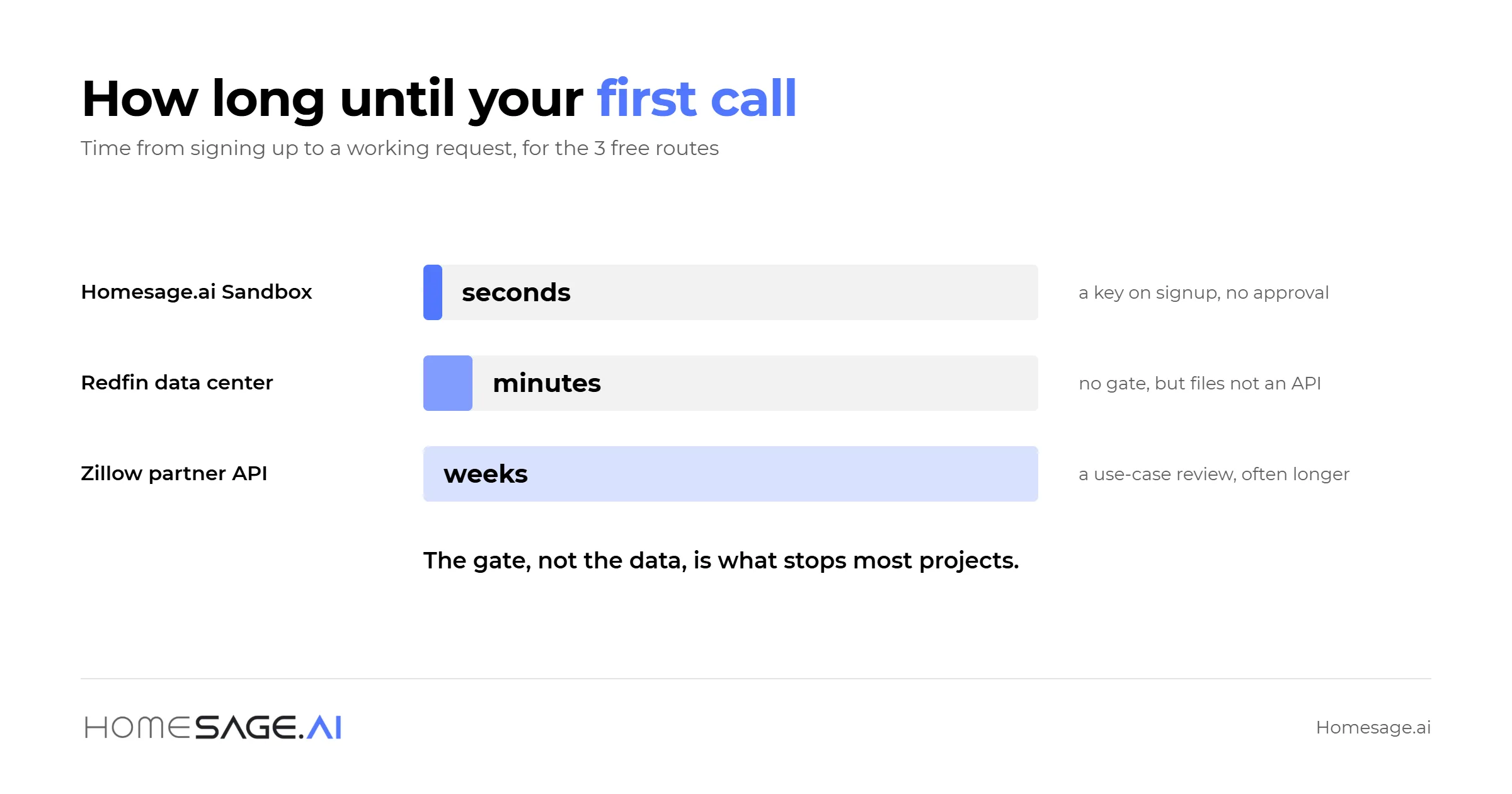
3 of the 7 have a genuinely free route, and a free real estate API is only 1 of the 3 shapes it takes. The difference is not the data. It is the gate in front of it.
| Free route | How you get in | Per-address lookup | Best for |
|---|---|---|---|
| Zillow research | Download the files, or apply for API access | Only through the gated API | Market research and trends |
| Homesage.ai Sandbox | A key in seconds, no approval | Yes, including property condition and value | Building and testing quickly |
| Redfin data center | Download, no account needed | No | Open market data and charts |
Counting the listings that match a filter costs nothing, so a market’s shape is free to explore before you spend anything. Cleveland had 1,174 active listings on 20 September 2026.
Where free real estate data stops
- It rarely values a specific address. Market files describe geographies, not houses.
- It carries no condition signal. Nothing in a public dataset tells you the kitchen is original.
- It lags. Published files refresh monthly or quarterly, which is fine for trends and useless for an offer.
- It arrives unstandardized. County formats differ, and reconciling them is the hidden cost of free.
- Free tiers are sized for testing. The moment something runs daily in production, every free route here ends.
CoreLogic competitors, and when to pick one
CoreLogic sets the reference point, so most shortlists start by asking who else does the job. 4 of the providers above compete with it directly, and each one competes on a different front.
| CoreLogic competitor | Competes on | Pick it when |
|---|---|---|
| ATTOM | Breadth and record standardization | You are building a platform and need stable property IDs |
| Homesage.ai | Property condition scores and investment analysis | The state of the property changes your answer |
| CoStar | Commercial coverage | The asset is commercial rather than residential |
| PropertyShark | Ownership depth in dense metros | You work 2 or 3 markets and need the owner behind the LLC |
CoreLogic stays the safer pick for regulated lending and insurance work. The others win wherever the job is narrower than its whole catalogue. Zillow and Redfin are not really competing with it at all, because neither sells the same thing.
How the 7 compare
| Provider | Strongest at | Free route | Best for |
|---|---|---|---|
| CoreLogic (Cotality) | Depth, risk analytics, compliance | No | Lenders and insurers |
| Homesage.ai | Property Condition scores and investment analysis | Yes, a Sandbox key | Investors, agents, proptech and Lenders |
| ATTOM | Breadth and record standardization | No | Platform builders |
| PropertyShark | Ownership depth in dense metros | No | Commercial analysts |
| Zillow | Consumer reach and market indices | Research files, gated API | Consumer products |
| CoStar | Commercial leasing and sales | No | Commercial professionals |
| Redfin | Open market data | Yes, no gate at all | Market research |
How to choose between property data providers
- Name the decision first. Underwriting a loan, ranking a flip and pricing a lease need different providers, and no single one wins all 3.
- Check coverage where you work, not nationally. A national figure says nothing about your county.
- Ask what arrives. Records need work before they answer anything. Analysis arrives as the answer.
- Test the access path. Partner approval and enterprise contracts are real timelines, and some teams never clear them.
- Start free where a free route exists, then plan the paid step before you depend on it.
- Look for a confidence signal. A provider that tells you when its estimate is weak is more useful than 1 that never does.
Ask Sage instead of exporting
You do not have to move data anywhere to use ours. Sage is our assistant, and it runs the same analyses from a plain-language question inside the AI tool you already use.
Connect Homesage.ai to Claude, ChatGPT or Gemini through our MCP connector and describe what you need.
“Screen Cleveland for houses that need work and grade Excellent.”
Sage previews the count and the credit cost before spending anything, then returns the addresses with their condition scores and estimated returns. The work runs against your own account and balance.
Here is a short video on turning property data into a shortlist.
Key takeaways
- 7 providers are worth shortlisting in 2026. The list is short because most teams only need 1 of them.
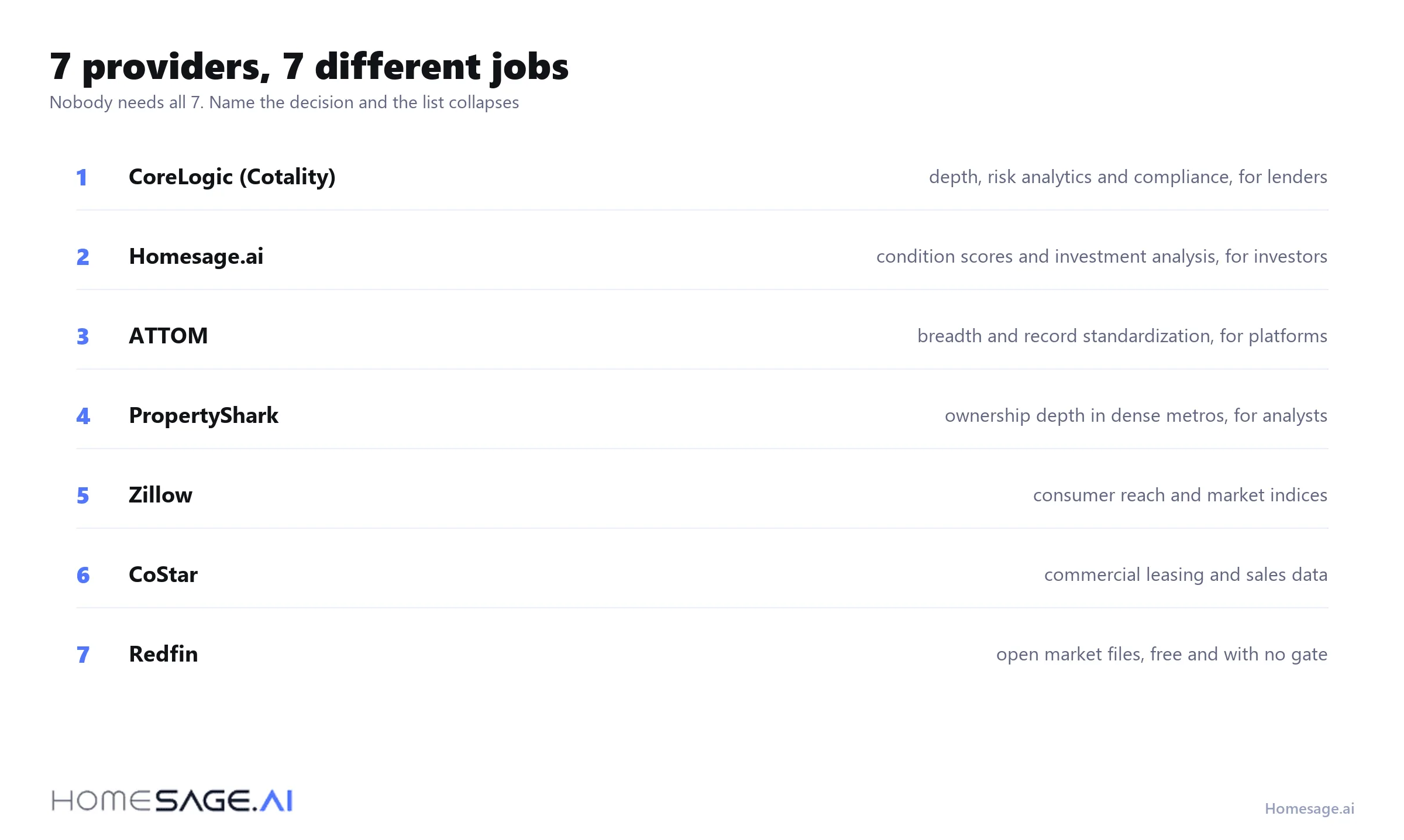
- They do different jobs. Breadth for platforms and depth for lenders. Analysis for investors, metro depth for commercial analysts and reach for consumer products.
- 3 have a free route, and they differ by gate rather than by data. A Sandbox key takes minutes, Redfin has no gate, Zillow reviews your use case over weeks.
- Records are not answers. We took Cleveland from 1,174 active listings to 29 candidates in 4 filters on 20 September 2026.
- Free data describes markets well and prices individual houses badly, because it carries no condition signal.
Conclusion
Nobody needs all 7. The shortlist collapses as soon as you name the decision the data has to support. The right provider answers it without a week of preparation, and 3 of these let you find that out for nothing first. Start a free Sandbox key and run an address you already know, then compare what comes back with what you use today.
Estimated values. Not investment advice. Data as of 2026-09-20. This article is general information. The Cleveland counts come from a Homesage.ai Investment Property Search run on 20 September 2026 and change daily.
Third-party coverage figures and access terms are the vendors’ own published numbers and change without notice. Evaluate every property against your own finances, local costs and a professional inspection.





Simon August 25, 2025
Very helpful!
N August 26, 2025
Helpful insights!