
What the 1% rule means
The 1% rule is a quick screen for rental properties. Multiply the price by 1% to get the monthly rent the rule asks for, then compare it with the rent the property can earn.
Monthly rent ÷ purchase price = 1% or more. Our guide on how much you can rent a property for explains how to set the rent figure you test.
- Price: the price you pay, plus any repairs you fund before renting.
- Rent: a rent estimate for the exact address, checked against similar rentals.
- Result: 1% or more passes the screen, less than 1% misses.
- Use: a first filter, before you count a single cost.
A real example from 2 Homesage.ai reports
We ran a Full Property Report on 2 single-family properties listed for sale on 14 October 2026.
| What the report shows | Detroit, MI 48214 | Phoenix, AZ 85015 |
|---|---|---|
| List price | $165,000 | $395,000 |
| Condition score | Excellent | Excellent |
| Rent estimate | $1,726 a month | $2,525 a month |
| Rent the 1% rule asks for | $1,650 a month | $3,950 a month |
| Rent as a share of price | 1.05% | 0.64% |
| Result | Passes | Misses by $1,425 a month |
The Detroit property earns $76 a month more than the rule asks. The Phoenix property needs a price of $252,500 to pass at its current rent estimate. That is $142,500 below its list price.
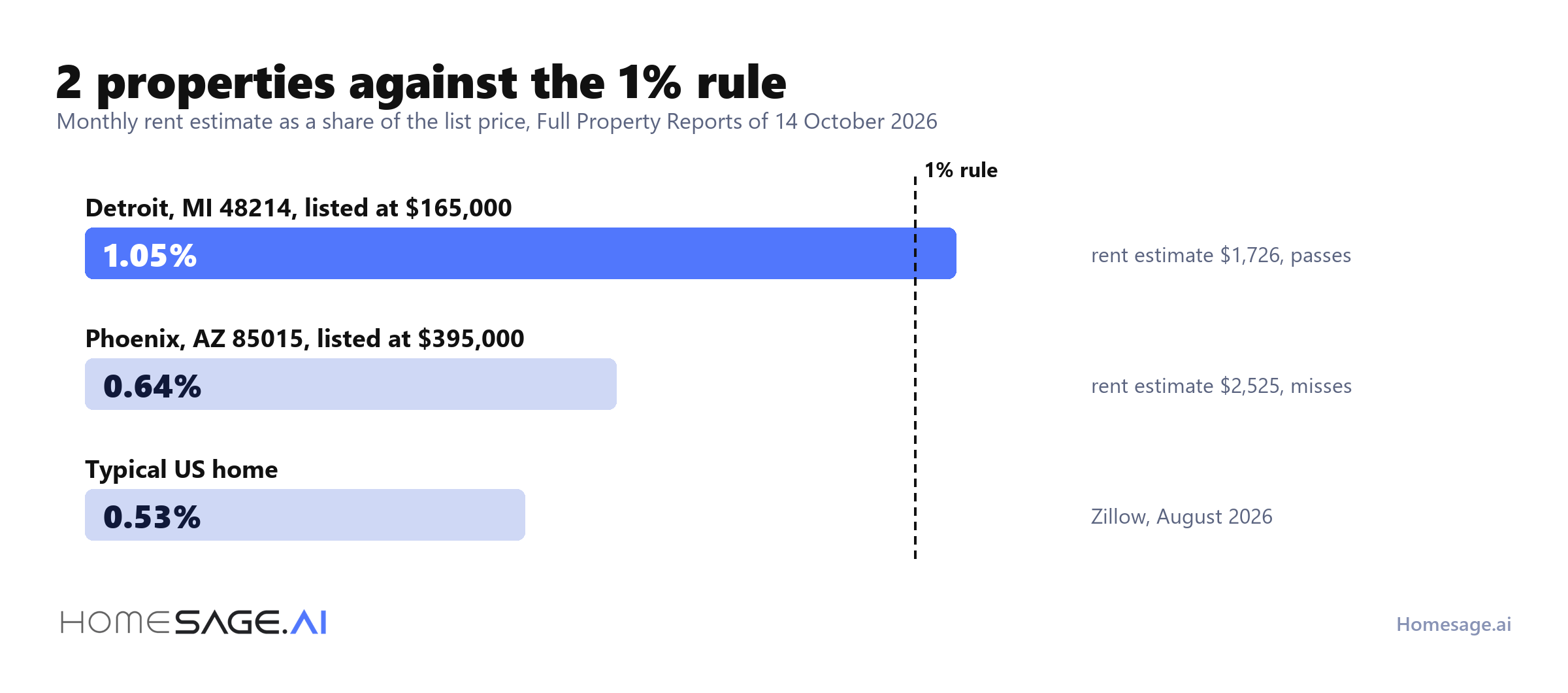
The Phoenix property passes the 1% rule only at $252,500, which is $142,500 below its list price.
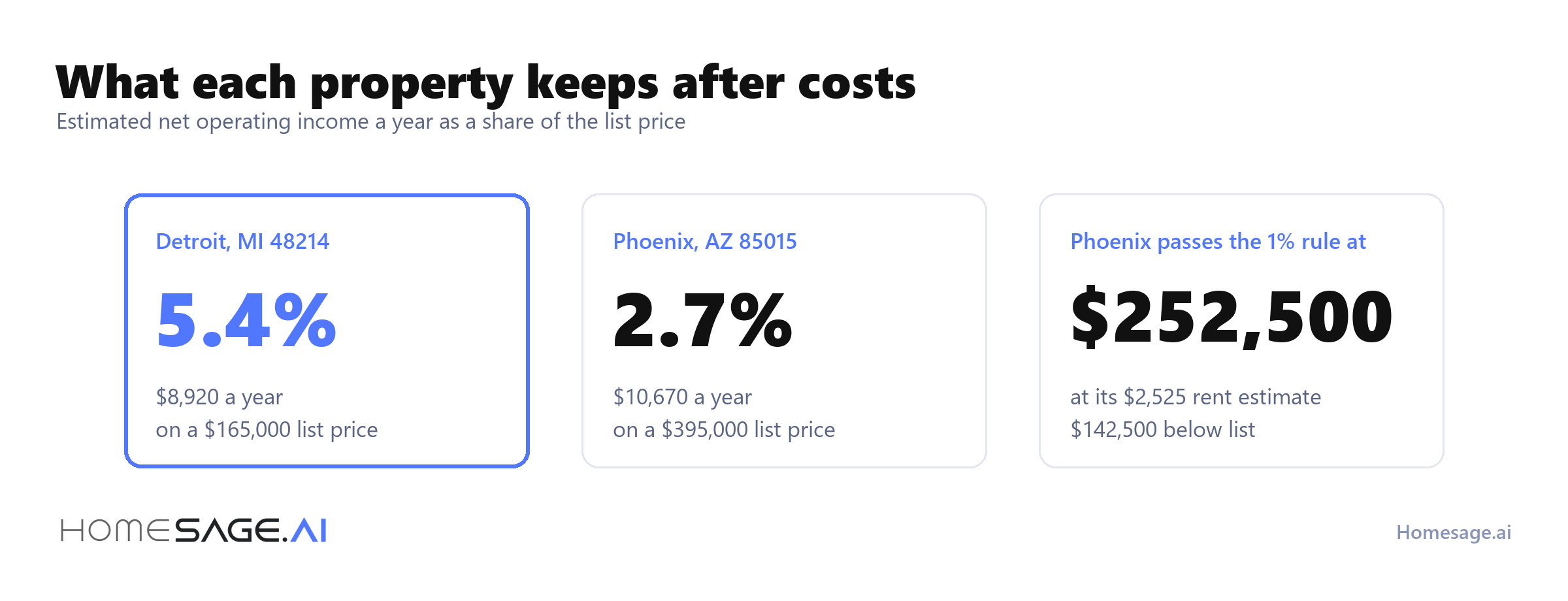
Passing puts a property on your shortlist, and the costs decide whether it earns money. Each report's long-term rental view sets monthly expenses against the estimated monthly revenue. That revenue starts slightly below the rent estimate, $1,667 against $1,726 for the Detroit property. Expenses take 55% of revenue in Detroit and 64% in Phoenix. The Detroit property keeps an estimated $8,920 a year, 5.4% of its list price. The Phoenix property keeps $10,670, only 2.7% of its list price.
How to work out the 1% rule on a property
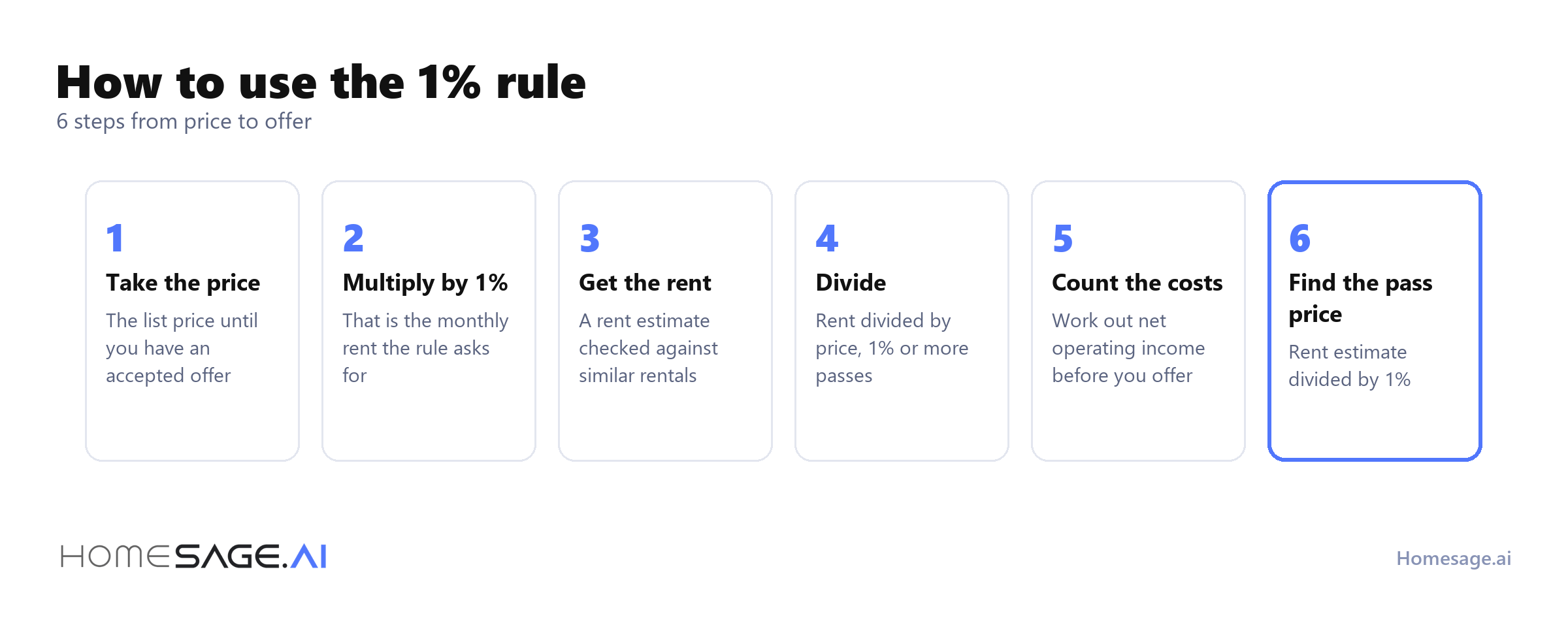
- Take the price you would pay. Use the list price until you have an accepted offer.
- Multiply it by 1%. That is the monthly rent the rule asks for.
- Get a rent estimate for the exact address, then check it against 3 to 5 similar rentals nearby.
- Divide the rent by the price. At 1% or more, the property passes the screen.
- For a property that passes, list the monthly costs and work out the net operating income before you offer.
- For a property that misses, divide the rent estimate by 1% to find the price at which it would pass.
What moves a property up or down against the 1% rule
Price matters more than rent. The Phoenix property costs 2.4 times the Detroit property, while its rent estimate is only 1.5 times higher. That gap is why the rule favours lower-priced markets.
Price cuts move the result too. The Phoenix list price fell from $435,000 on 7 August to $395,000 on 13 October, which lifted its rent share from 0.58% to 0.64%. It still needs another $142,500 off to reach 1%.
Common 1% rule mistakes to avoid
- Treating a pass as profit: The rule uses gross rent. The 2 reports above put expenses at 55% and 64% of revenue.
- Leaving out repairs: If a property needs work before a tenant moves in, add the estimated renovation cost to the price before you test it.
- Testing the short-term figure: The Phoenix report estimates $3,506 a month as a short-term rental. That is 0.89% of its price before cleaning and platform fees.
- Trusting one rent figure: Test the rent estimate against similar rentals from the last 90 days before you rely on it.
Frequently asked questions
Does the 1% rule use the purchase price or the property's value?
How does the 1% rule relate to the gross rent multiplier?
Does the 1% rule work for short-term rentals?
What do I do with a property that misses the 1% rule?
Is the 1% rule realistic for the typical home?
Ask Sage whether a property passes the 1% rule
Sage, our assistant, returns a rent estimate for any US address from inside the AI tool you already use.
- Homesage.ai Full Property Reports for single-family properties in Detroit (48214) and Phoenix (85015), generated 2026-10-14.
- Zillow August 2026 Market Report, published 2026-09-08.